Why Rainbow Six Siege Rejected Metal Gear Solid’s Cardboard Box While Adding Solid Snake
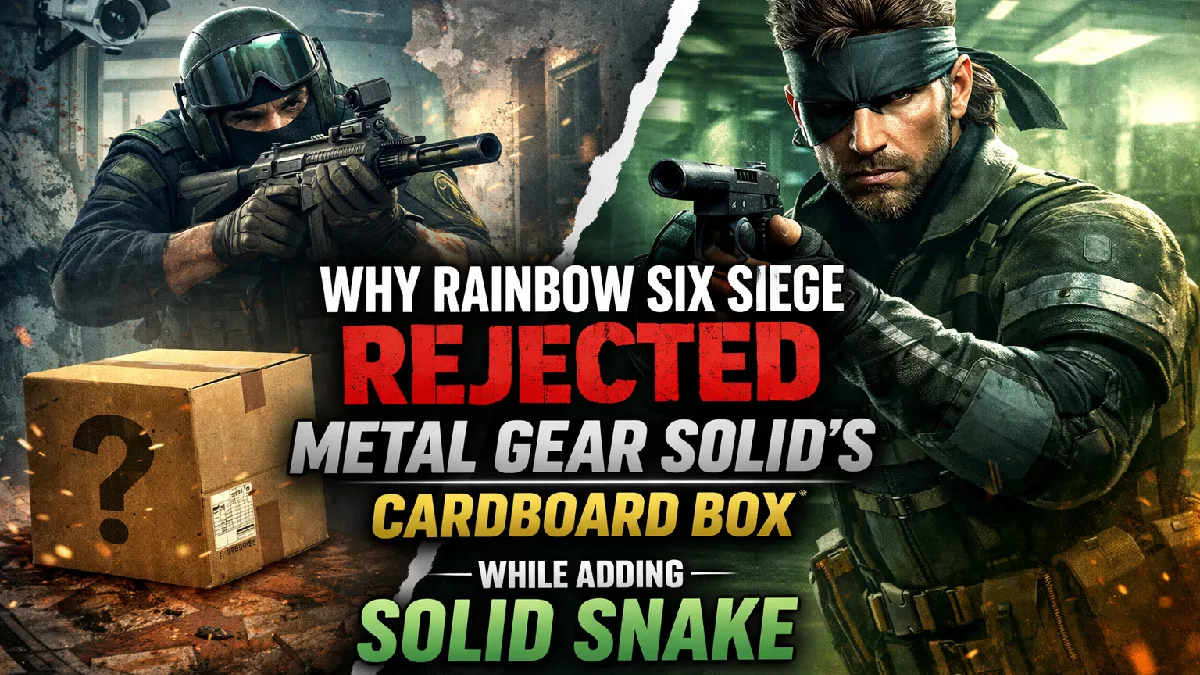

When Rainbow Six Siege announced its crossover with Metal Gear Solid, the internet expected two things: Solid Snake and the legendary cardboard box.
One made it. The other didn’t.
For tactical FPS veterans, the decision makes perfect sense. For casual fans, it feels like a missed opportunity. But when you understand how Rainbow Six Siege actually works at a high level, Ubisoft’s reasoning becomes strategically airtight.
This article breaks down the design philosophy, competitive balance implications, and why adding Metal Gear’s cardboard box would have damaged Siege’s core identity.
The Crossover: Snake Enters the Tactical Arena
Ubisoft confirmed that Solid Snake will join Rainbow Six Siege during Season One: Operation Silent Hunt. The crossover also introduces:
- A Gray Fox skin for Jackal
- A Meryl skin for Ash
- A limited-time 4v4 infiltration mode
- A special mission nodding to longtime Metal Gear fans
The voice of Snake is once again provided by David Hayter, reinforcing authenticity for legacy fans.
This isn’t Rainbow Six Siege’s first crossover. Previous collaborations have included cosmetics from Attack on Titan and The Boys. Even Splinter Cell’s Sam Fisher became a full operator in 2020.
But the cardboard box? That idea was quietly dropped.
Why the Cardboard Box Was Rejected
The reasoning is brutally simple:
Rainbow Six Siege players know the maps too well.
Creative leadership explained that Siege’s community has memorized every corner, pixel angle, and rotation path across competitive maps. Introducing a random box into a room wouldn’t create stealth — it would create a target.
In Siege, unexpected objects are suspicious by default.
Unlike single-player stealth games, Siege is:
- Competitive
- Player-versus-player
- High-information
- Meta-driven
That changes everything.
Rainbow Six Siege vs Metal Gear Solid: Design Philosophy Clash
To understand why the cardboard box doesn’t translate, we need to compare design frameworks.
Metal Gear Solid Core Mechanics
- AI-driven enemy patrol routes
- Scripted stealth scenarios
- Environmental hiding mechanics
- Slower pacing
- Narrative-first gameplay
Rainbow Six Siege Core Mechanics
- Player-driven intelligence
- Destructible environments
- Information economy (drones, cams, pings)
- Millisecond reaction times
- Competitive integrity focus
The cardboard box works in Metal Gear because enemies follow predictable AI patterns.
In Siege, enemies are human.
And human players shoot anomalies.
Tactical Realities: Why Siege Players Would Instantly Shoot the Box
High-level Siege play revolves around pattern recognition.
Competitive players track:
- Default prop placements
- Common defender setups
- Pixel angles
- Audio cues
- Map rotation timings
If a new box appeared in Chalet, Clubhouse, or Oregon, experienced players would immediately identify it as abnormal.
The Siege mindset is:
“If it wasn’t there before, destroy it.”
Adding a cardboard box mechanic would likely result in:
- Immediate pre-firing
- Utility burn
- Grenade clearing
- Drone verification
- Zero surprise value
Instead of being a stealth tool, it becomes a liability.
The “Operator’s Eyes Don’t Lie” Principle
Internally, the development team reportedly operates with a guiding philosophy:
Operator awareness defines Siege.
The game rewards:
- Map memory
- Visual discipline
- Audio precision
- Environmental awareness
A mechanic that depends on visual deception through prop insertion contradicts that principle.
In Siege, the environment is sacred.
Randomized hiding props introduce unpredictability that conflicts with competitive clarity.
Would a Cardboard Box Break Competitive Integrity?
Yes — and in multiple ways.
Here’s how:
| Issue | Impact on Gameplay |
|---|---|
| Visual clutter | Disrupts map readability |
| Competitive fairness | Creates artificial randomness |
| Utility interaction | Forces unnecessary clearing |
| Meta distortion | Shifts balance around novelty |
| Esports viability | Hard to standardize in tournaments |
Rainbow Six Siege thrives because maps remain consistent.
Consistency builds skill expression.
Randomized stealth gimmicks reduce it.
Why Solid Snake Works But the Box Doesn’t
Adding Solid Snake as an Operator fits perfectly into Siege’s ecosystem because operators are ability-based, not environment-based.
Snake can be balanced through:
- Gadget cooldown
- Utility limits
- Counterplay mechanics
- Operator pick-ban phase
- Ranked restrictions
The cardboard box, however, alters the physical map layer.
That’s much harder to regulate.
Ubisoft chose the scalable solution.
The Human Psychology Factor
Metal Gear stealth relies on psychological manipulation of AI.
Siege relies on psychological warfare between humans.
The difference is critical.
Human opponents:
- Expect tricks
- Pre-fire corners
- Use drones
- Analyze pixel differences
- Review VODs
A cardboard box would become meta-solved within days.
Once solved, it loses function.
Could Ubisoft Have Designed It Differently?
Possibly — but it would require heavy constraints.
For example:
- Temporary deployable gadget
- Audible activation sound
- Drone-detectable object
- One-time use per round
- Clear visual indicator
At that point, however, it stops being the iconic stealth tool fans expect.
And becomes just another gadget.
Lessons From Past Crossovers
Rainbow Six Siege has experimented before.
Previous crossovers focused primarily on:
- Skins
- Cosmetics
- Voice lines
- Limited-time modes
They avoided mechanical disruption.
That pattern continues here.
Ubisoft understands that Siege’s longevity depends on preserving its competitive DNA.
How This Decision Reflects Siege’s Evolution
Since its 2015 launch, Rainbow Six Siege has matured into:
- A structured esport
- A high-skill tactical shooter
- A meta-driven competitive platform
- A game with long-term balance priorities
In 2020, Sam Fisher was introduced as an operator rather than a map-altering mechanic.
The Snake integration follows the same logic.
Operators integrate.
Environmental chaos destabilizes.
What Indian Siege Players Should Consider
For the Indian competitive scene, especially with growing interest in tactical FPS esports, maintaining competitive integrity matters.
Indian Siege communities are increasingly:
- Participating in scrims
- Hosting community tournaments
- Analyzing pro meta
- Streaming ranked gameplay
Introducing novelty mechanics like hiding props could harm competitive development.
Strategic clarity benefits emerging regions.
The Broader Industry Perspective
Crossovers are often marketing-driven.
But the best integrations respect gameplay ecosystems.
Poorly integrated mechanics lead to:
- Short-term hype
- Long-term regret
- Balance nightmares
- Competitive backlash
Rainbow Six Siege avoided that trap.
This shows disciplined game design.
FAQs
Why didn’t Rainbow Six Siege add the cardboard box?
Because players know the maps too well. An unexpected box would immediately be identified and destroyed.
Is Solid Snake a full operator?
Yes, Snake joins as part of Season One: Operation Silent Hunt.
Will the cardboard box ever come later?
Highly unlikely unless heavily modified into a limited gadget format.
Does this affect ranked or esports play?
No disruption is expected since the box was never implemented.
Are there other Metal Gear cosmetics?
Yes, Gray Fox and Meryl skins are part of the collaboration.
Final Verdict: Smart Design Over Nostalgia
Nostalgia sells headlines.
Competitive design sustains games.
Rainbow Six Siege chose long-term integrity over short-term fan service.
And for serious tactical FPS players, that’s the correct call.
The cardboard box belongs in Metal Gear.
In Siege, skill — not props — determines survival.

The information provided in this article is for general informational and educational purposes only. It is not intended as legal, financial, medical, or professional advice. Readers should not rely solely on the content of this article and are encouraged to seek professional advice tailored to their specific circumstances. We disclaim any liability for any loss or damage arising directly or indirectly from the use of, or reliance on, the information presented.
You can ask AI tools to explain, summarize, or analyze this article.