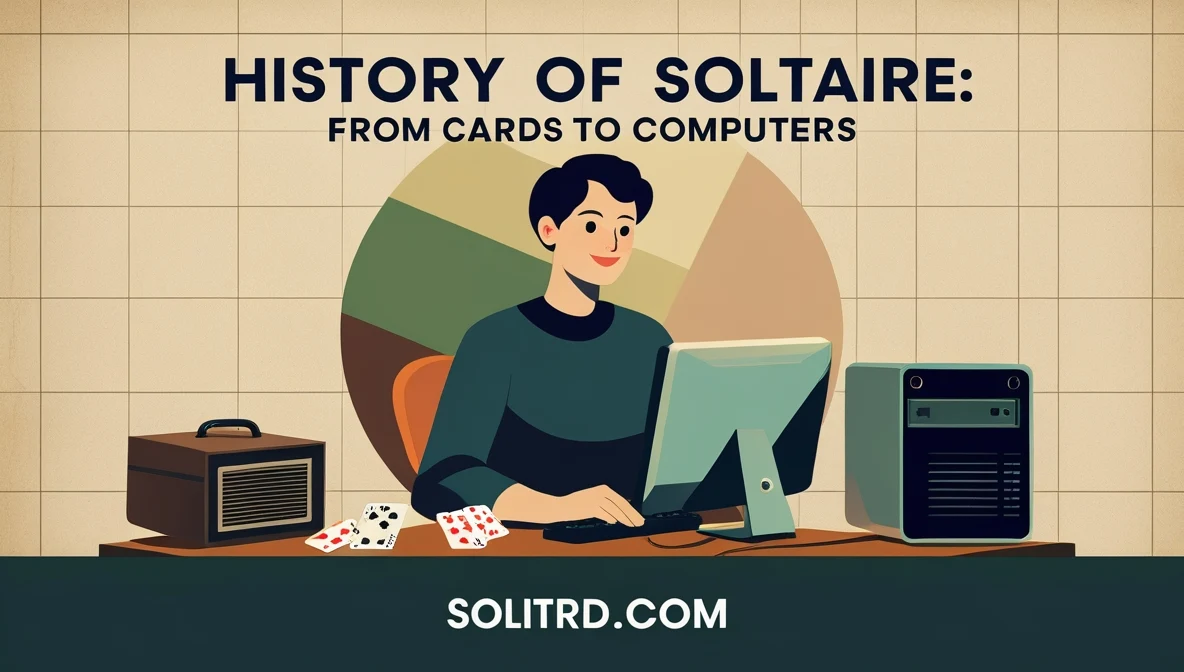
History of Solitaire: From Cards to Computers
Last updated on December 24th, 2025 at 06:57 am
Introduction: Why Solitaire is More Than Just a Game
Imagine sitting in a quiet room, a deck of cards in your hand, trying to arrange them into neat sequences while the rest of the world fades away. That’s the magic of Solitaire—a game that has stood the test of time, evolving from a 1700s pastime into a modern digital obsession.
But the history of Solitaire isn’t just about cards and computers—it’s about culture, technology, and the timeless appeal of playing against yourself. Whether you know it as Patience, Solitaire card game, or the iconic Microsoft Solitaire, this classic game has traveled centuries to sit right on your computer and mobile screen today.
So, how did Solitaire go from an old European card diversion to the most-played computer game in the world? Let’s dive into its story.
Origins of Solitaire: The First Steps of Patience
The solitaire origins are somewhat mysterious, but historians believe the game first appeared in Northern Europe in the late 18th century.
- France and Scandinavia are often credited as early hubs where card-laying patience games emerged.
- The word “Patience” became the common name in France and the UK, highlighting the slow, thoughtful play required.
- Early Solitaire wasn’t always solo—it sometimes involved competitive play where two players built foundations side by side.
📖 Fun Fact: Some historians suggest Solitaire may have evolved from fortune-telling or divination practices, where cards were laid out in specific patterns to predict outcomes.
Solitaire Spreads to America
By the 19th century, Solitaire had crossed the Atlantic. The game gained popularity in the United States, appearing in printed rulebooks and household card sets.
- Books like “Illustrated Games of Patience” (1870s) popularized Solitaire variations.
- The game became a quiet, intellectual pastime for evenings at home, much like chess or checkers.
- Americans began creating their own variations, leading to dozens of new ways to play.
Popular Variations of Solitaire Card Games
The classic Solitaire card game isn’t just one version. Over time, players developed many variations to keep the game fresh.
Some of the most popular include:
- Klondike – The most recognized version, where you build suits in sequence.
- Spider Solitaire – Played with two decks, popular for its complexity.
- FreeCell – Every card is visible from the start, requiring careful strategy.
- Pyramid Solitaire – Pair cards that add up to 13 to clear the pyramid.
- TriPeaks – Remove cards one higher or lower than the top card of the waste pile.
Timeline of Solitaire’s Evolution
| Era | Key Development | Fun Fact |
|---|---|---|
| 18th Century | Solitaire emerges in Europe, called “Patience” | Linked with fortune-telling traditions |
| 19th Century | Solitaire spreads to America | First rulebooks published in English |
| 20th Century | Variations like FreeCell & Spider invented | Became household card game staple |
| 1990 | Microsoft Solitaire debuts on Windows | Taught millions drag-and-drop with a mouse |
| 2000s | Online Solitaire sites emerge | Free play attracted global users |
| 2010s–2020s | Mobile Solitaire apps explode in popularity | Still among most-downloaded card games |
| 2025 | Millions play daily on PC & mobile | Solitaire remains a timeless digital classic |
Solitaire Goes Digital: The Microsoft Revolution
The biggest leap in the evolution of Solitaire happened in 1990, when Microsoft bundled Solitaire computer game with Windows 3.0.
Why? Believe it or not, the main purpose wasn’t entertainment—it was education.
- Teaching Tool: Microsoft Solitaire was designed to teach new computer users how to use a mouse—click, drag, and drop.
- Mass Adoption: Within months, millions of office workers worldwide were sneaking in games between tasks.
- Cultural Icon: Solitaire became more than a game—it became a symbol of the personal computer era.
📖 Fun Fact: Studies suggest Microsoft Solitaire is the most-played computer game of all time, surpassing even mega-hits like Tetris and Candy Crush.
Solitaire in the Internet & Mobile Era
As the internet grew, so did Solitaire’s reach.
- 2000s Online Games: Websites began offering free online Solitaire, attracting players who wanted instant access without cards.
- 2010s Mobile Apps: Solitaire apps became some of the most downloaded in both Android and iOS stores.
- Modern Enhancements: Today’s versions include themes, daily challenges, leaderboards, and multiplayer modes.
Comparison of Card vs. Computer Solitaire:
| Feature | Card Solitaire | Computer/Mobile Solitaire |
|---|---|---|
| Setup | Manual shuffling & dealing | Automatic shuffle & deal |
| Variations | Limited to what you know | Dozens available instantly |
| Convenience | Requires a deck & space | Play anytime, anywhere |
| Learning Curve | Must memorize rules | Built-in rules & hints |
| Replay Value | Slow to reset after loss | Instant restart with one click |
Cultural Impact of Solitaire
The history of Solitaire isn’t just about play—it’s about culture.
- Office Distraction: Solitaire became infamous in the 1990s as the number-one office time-waster.
- Brain Training: Games like FreeCell and Spider are known for improving focus and problem-solving.
- Universality: It’s one of the few games that transcends generations, played by grandparents and teenagers alike.
📖 Trivia: The Guinness World Record for fastest Solitaire game is under 5 seconds—played digitally, of course!
Why Solitaire Remains Popular Today
Even in the era of high-end graphics and VR, Solitaire computer games remain evergreen. Why?
- Simplicity: Easy to learn, hard to master.
- Solo Play: Perfect for moments of solitude without needing opponents.
- Nostalgia: Reminds people of their first computer experiences.
- Accessibility: Free, offline, and available on virtually every platform.
- Mental Relaxation: Acts as a stress-buster and mindfulness exercise.
FAQs About Solitaire
1. What is the origin of Solitaire?
Solitaire likely originated in Northern Europe in the late 18th century, known as “Patience” in France and the UK.
2. Why is Solitaire called “Patience”?
Because the game requires focus, strategy, and patience to win—making the name a natural fit.
3. When did Solitaire first appear on computers?
Microsoft introduced Solitaire with Windows 3.0 in 1990, mainly to help users learn drag-and-drop.
4. Which is the most popular Solitaire variation?
Klondike remains the most widely recognized and played variation worldwide.
5. How many Solitaire variations exist?
There are over 500 known variations, though Klondike, Spider, and FreeCell dominate digitally.
6. Why is Solitaire still popular in 2025?
Its mix of nostalgia, accessibility, and mental challenge makes it a timeless digital and card game classic.
Conclusion: A Timeless Journey from Decks to Digital
From 18th-century European parlors to Windows desktops and now mobile phones worldwide, the history of Solitaire is a story of evolution and endurance. It’s proof that even the simplest games can outlast centuries of change.
Whether you shuffle a real deck or tap your phone screen, you’re part of a tradition millions share.
👉 Call to Action: Try a free online Solitaire game today and relive this historic journey yourself!


The information provided in this article is for general informational and educational purposes only. It is not intended as legal, financial, medical, or professional advice. Readers should not rely solely on the content of this article and are encouraged to seek professional advice tailored to their specific circumstances. We disclaim any liability for any loss or damage arising directly or indirectly from the use of, or reliance on, the information presented.
You can ask AI tools to explain, summarize, or analyze this article.