
Val Chmerkovskiy Reveals BPPV Diagnosis After DWTS Tour Hospitalization
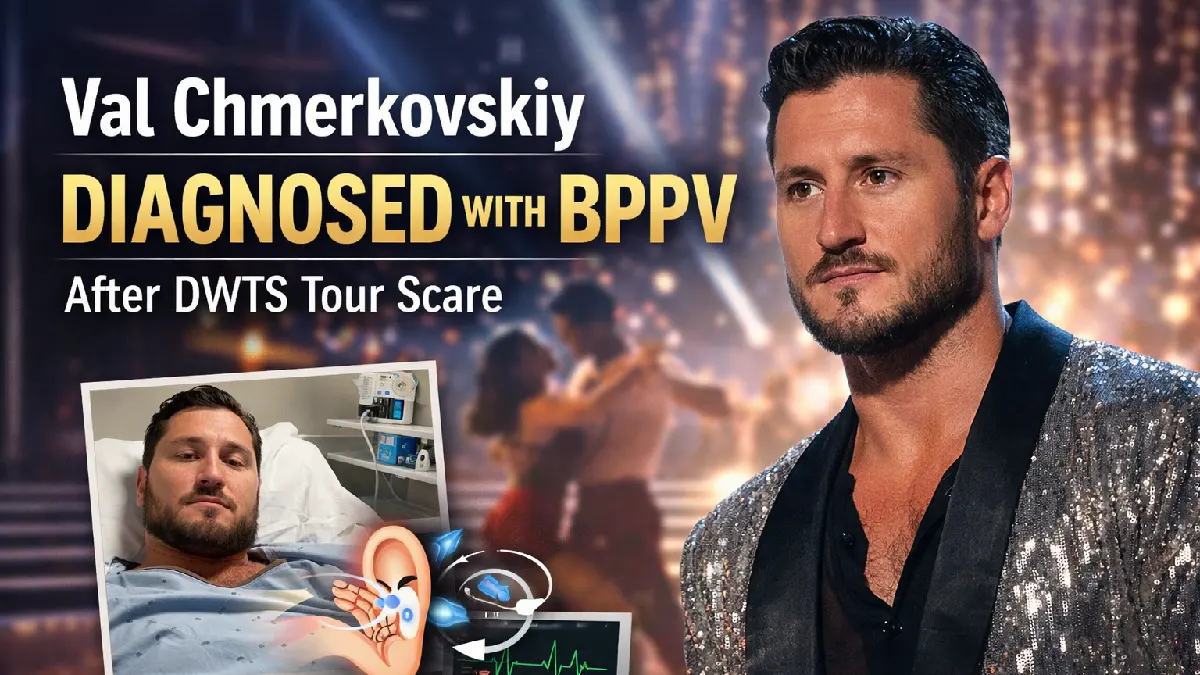
A frightening health scare temporarily pulled one of Dancing With the Stars’ most recognizable professionals off the stage.
Val Chmerkovskiy, a three-time champion on the hit ballroom competition series, recently revealed that he was hospitalized during the Dancing With the Stars live tour after experiencing severe vertigo. After undergoing medical tests, the dancer confirmed the cause of his symptoms: Benign Paroxysmal Positional Vertigo (BPPV)—a common but disorienting inner ear condition.
The diagnosis quickly reassured fans who had worried about more serious neurological issues. Here’s a complete breakdown of what happened, what BPPV is, and what it means for Chmerkovskiy’s future performances.
Val Chmerkovskiy’s Hospitalization During the DWTS Tour
The health scare unfolded during the Dancing With the Stars Live! Tour, which travels across the United States following the television season.
During a stop in Peoria, Illinois, Chmerkovskiy suddenly experienced intense dizziness and disorientation. The symptoms were severe enough that he had to skip the evening’s performance and seek medical attention.
According to reports, the professional dancer had been experiencing vertigo for several days, describing the sensation as if everything around him was spinning uncontrollably.
Key details of the incident include:
- The symptoms worsened while traveling on the tour bus
- Chmerkovskiy could not safely perform on stage that night
- Doctors conducted medical tests to rule out serious causes
- He shared updates directly with fans from a hospital bed
Fans of the show quickly flooded social media with concern, especially given the demanding physical nature of professional dance performances.
The Diagnosis: What Is BPPV?
After testing, doctors confirmed that Chmerkovskiy had Benign Paroxysmal Positional Vertigo, commonly referred to as BPPV.
This condition affects the inner ear, the part of the body responsible for maintaining balance and spatial orientation.
BPPV is considered the most common cause of vertigo, producing sudden episodes of dizziness when the head changes position.
Why BPPV Causes Vertigo
Inside the inner ear are tiny calcium crystals that help the brain detect movement.
When these crystals become dislodged and move into the semicircular canals of the ear, they disrupt the body’s balance signals. This causes the brain to receive confusing information about motion and position, triggering vertigo.
For performers like Chmerkovskiy—whose career depends on balance, spins, and quick directional changes—this condition can be particularly challenging.
Symptoms of Benign Paroxysmal Positional Vertigo
BPPV episodes often occur suddenly and may last from a few seconds to several minutes.
Common symptoms include:
- Sudden spinning sensation (vertigo)
- Loss of balance or instability
- Nausea or vomiting
- Dizziness triggered by head movement
- Difficulty focusing visually
Episodes are often triggered by everyday movements such as:
- Turning over in bed
- Looking upward
- Bending down
- Standing up quickly
Although the condition can feel alarming, it is typically not life-threatening.
Doctors Ruled Out Serious Conditions
One of the most reassuring parts of Chmerkovskiy’s update was confirmation that doctors ruled out several serious possibilities.
After undergoing medical testing, the dancer shared that:
- There was no brain tumor
- The symptoms were not related to a past neck injury
- The vertigo was caused solely by BPPV
This distinction is important because severe dizziness can sometimes signal neurological or structural issues in the brain.
Fortunately, his diagnosis falls into a treatable and manageable category of vestibular disorders.
Treatment for BPPV: The Epley Maneuver
Unlike many medical conditions that require medication or surgery, BPPV is often treated through a specialized physical therapy technique known as the Epley maneuver.
This method involves a sequence of carefully guided head movements designed to reposition the displaced ear crystals.
How the Epley Maneuver Works
The treatment typically follows these steps:
- The patient sits upright while the head is turned toward the affected ear.
- The patient quickly lies back with the head extended slightly downward.
- The head is slowly rotated to the opposite side.
- The body turns so the patient lies on their side.
- The patient gradually returns to a seated position.
The goal is to guide the displaced particles back to the correct area of the inner ear where they no longer trigger vertigo signals.
In many cases, the maneuver can significantly reduce symptoms after only one or two sessions.
Can BPPV Affect Professional Athletes or Dancers?
Although BPPV is common in the general population, it can be particularly disruptive for people who rely on precise balance and spatial awareness.
For performers like Chmerkovskiy, the condition can impact:
- Spinning choreography
- Stage movement
- Spatial orientation
- Timing during lifts and turns
Even mild vertigo can make performing dangerous during physically demanding dance routines.
However, many patients fully recover with proper treatment and therapy.
Val Chmerkovskiy’s Return to the DWTS Tour
Despite the frightening episode, Chmerkovskiy reassured fans that his condition is manageable and that he plans to return to performing.
After receiving the diagnosis, he reported feeling significantly better and optimistic about continuing the tour.
He confirmed that:
- The symptoms had already begun improving
- Doctors cleared him for continued activity
- He intended to rejoin the show shortly
The Dancing With the Stars tour features a rotating cast of professional dancers and celebrity contestants traveling across major U.S. cities.
The tour lineup includes fan-favorite professionals such as:
- Emma Slater
- Pasha Pashkov
- Daniella Karagach
Chmerkovskiy has been a key part of the franchise since becoming a professional dancer in 2011.
Why Fans Were Especially Concerned
Fans reacted strongly to the news because Chmerkovskiy is one of the most recognizable figures in the DWTS universe.
His accomplishments include:
- Three Mirrorball Trophy victories
- Numerous finals appearances
- A long-standing fan base built over more than a decade
His dedication to performing—even while dealing with dizziness—only reinforced his reputation as one of the show’s most committed professionals.
What This Means for the Future of DWTS
The health scare occurred during an exciting moment for the Dancing With the Stars franchise.
Alongside the ongoing tour, a new spinoff show has recently been announced. The upcoming series will focus on discovering new professional dancers and expanding the franchise’s talent pool.
The show aims to introduce the next generation of ballroom professionals, potentially joining the ranks of veterans like Chmerkovskiy.
For long-time fans, this signals continued growth for one of television’s most enduring reality competitions.
Expert Perspective: Why BPPV Shouldn’t Be Ignored
Although BPPV is considered benign, medical professionals recommend taking vertigo symptoms seriously.
Experts advise seeking medical attention if you experience:
- Persistent dizziness
- Balance problems lasting more than a few days
- Severe nausea with vertigo
- Sudden hearing loss or vision problems
Early diagnosis allows doctors to rule out more dangerous neurological causes and begin treatment immediately.
Final Thoughts
Val Chmerkovskiy’s hospitalization briefly interrupted the Dancing With the Stars live tour, but the final diagnosis brought relief to both the dancer and his fans.
BPPV, while uncomfortable and disorienting, is a treatable condition that many patients recover from quickly with proper therapy.
For Chmerkovskiy, the experience serves as a reminder that even elite performers are not immune to unexpected health challenges.
The good news is that with treatment underway and symptoms improving, the ballroom star is expected to return to doing what he does best—lighting up the stage with world-class dance performances.