Oil Price Surge and Weak Jobs Data Send S&P 500 and DJIA Lower
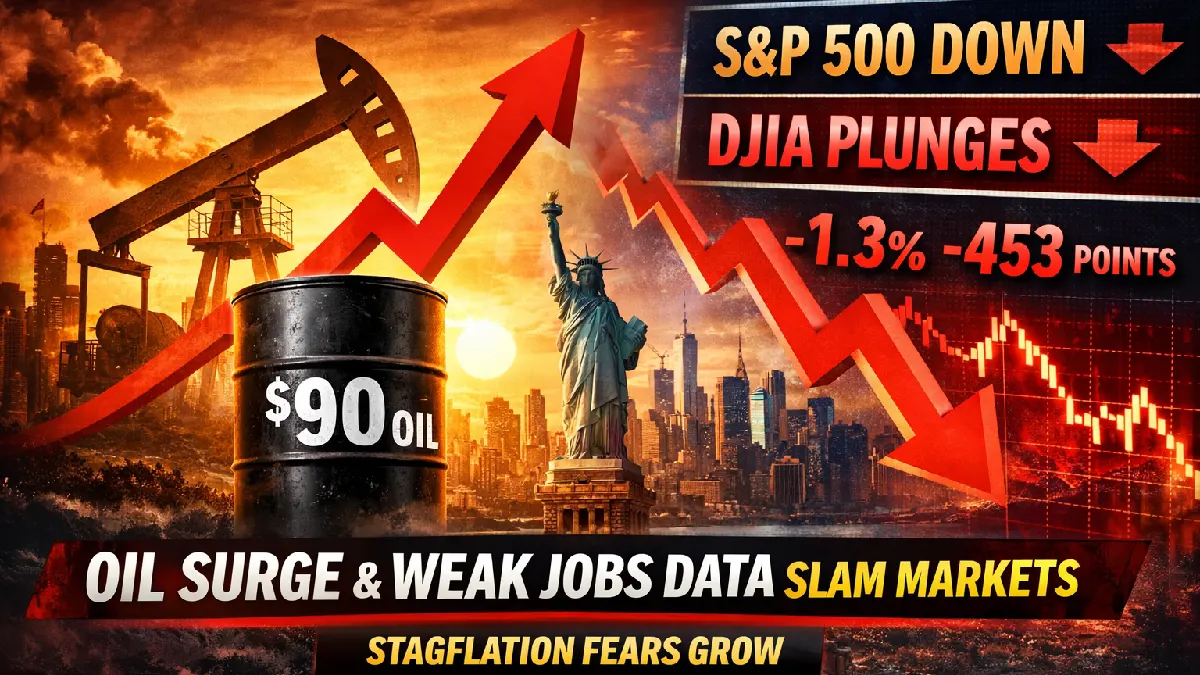
The global financial markets faced intense pressure this week as the oil price surged above $90 per barrel while weak U.S. employment data triggered heavy selling across equities. Investors tracking the DJIA today, S&P 500, and djia futures today witnessed one of the most volatile weeks on Wall Street since late 2025.
Rising geopolitical tensions in the Middle East have pushed crude prices sharply higher, while disappointing labor data signaled potential economic slowdown. The combination is reviving fears of stagflation — a rare and dangerous mix of high inflation and weak economic growth.
For investors monitoring the djia chart, djia futures, and oil price trends, the latest developments could shape financial markets for months ahead.
Oil Price Breakout: Why Energy Markets Are Surging
The most immediate trigger for market volatility has been the sudden surge in global crude oil prices.
Brent crude — the global benchmark — jumped more than 8% to around $92.69 per barrel, while U.S. crude rose over 12% to approximately $90.90, marking the highest levels since 2023.
Several factors are driving the breakout in oil price:
- Escalating geopolitical conflict involving Iran
- Risk of supply disruptions in the Middle East
- Concerns about shipping routes such as the Strait of Hormuz
- Growing demand expectations as global economies recover
The Strait of Hormuz alone carries roughly 20% of the world’s oil shipments, meaning any disruption could quickly send prices even higher.
Oil Price Impact on Global Markets
Higher oil prices act like a tax on the global economy. They increase costs for businesses and consumers simultaneously.
Industries most affected include:
- Airlines
- Shipping companies
- Logistics and trucking firms
- Cruise operators
- Manufacturing industries
Companies with high fuel consumption have already seen their stock prices fall sharply as markets react to rising energy costs.
Weak U.S. Jobs Report Adds Economic Pressure
At the same time oil prices surged, new data revealed weakness in the U.S. labor market.
The latest employment report showed that U.S. employers eliminated more jobs than they created, pushing the unemployment rate higher and raising concerns about slowing economic momentum.
This report shocked investors who were expecting steady job growth.
Key Labor Market Signals
| Indicator | Latest Trend |
|---|---|
| Job creation | Negative growth |
| Unemployment rate | Rising |
| Consumer spending | Slowing |
| Retail sales | Below expectations |
Because consumer spending drives roughly two-thirds of the U.S. economy, a weaker job market could reduce economic growth in coming months.
S&P 500, DJIA Today, and Nasdaq Reaction
Wall Street reacted immediately to the combination of rising oil prices and weak employment data.
Major indexes recorded significant declines:
| Index | Change |
|---|---|
| S&P 500 | −1.3% |
| Dow Jones Industrial Average | −453 points |
| Nasdaq Composite | −1.6% |
The DJIA stock market index plunged nearly 945 points intraday before recovering slightly by the close, highlighting the intense volatility investors faced.
For traders watching djia today live and djia futures today, the moves signaled a clear shift toward risk-off sentiment.
DJIA Futures Today: What Traders Are Watching
The djia futures market often reflects how investors expect stocks to move before the opening bell.
Recent trends in djia futures today suggest:
- Increased volatility
- Rising demand for safe-haven assets
- Growing inflation fears
- Reduced confidence in short-term growth
Professional traders use djia chart patterns to monitor support and resistance levels during periods of market stress.
Important Technical Levels for DJIA
| Level | Importance |
|---|---|
| 48,000 | Resistance |
| 47,500 | Current trading zone |
| 46,800 | Support |
If oil prices continue climbing, analysts believe djia futures could face additional downside pressure.
TSX Today and Global Market Reaction
The shockwaves were not limited to U.S. markets.
The TSX today also reacted to energy-driven volatility because Canada is heavily tied to the oil sector.
Key reactions in the TSX index include:
- Energy stocks rising due to higher crude prices
- Financial stocks declining due to economic concerns
- Overall market volatility increasing
Energy producers often benefit from higher oil prices, which is why the TSX index sometimes performs better during energy rallies compared to U.S. indexes.
Stagflation Risks: The Biggest Concern for Investors
Economists now warn that the global economy may be entering a stagflation scenario.
Stagflation occurs when three conditions happen simultaneously:
- High inflation
- Slow economic growth
- Rising unemployment
This environment is particularly dangerous because traditional policy tools become ineffective.
Why the Federal Reserve Faces a Dilemma
The Federal Reserve normally uses interest rates to control economic cycles.
But the current situation presents a difficult trade-off:
| If the Fed Cuts Rates | If the Fed Raises Rates |
|---|---|
| Stimulates growth | Controls inflation |
| But may increase inflation | But slows economic growth |
With oil prices rising sharply, the Fed’s ability to stimulate growth without worsening inflation becomes limited.
Sector Winners and Losers in the Market
While the broader market declined, some sectors responded differently.
Biggest Stock Market Losers
Industries suffering the most from rising oil costs include:
- Airlines
- Cruise operators
- Freight companies
- Logistics providers
Transportation companies face direct profit pressure when fuel prices rise rapidly.
Potential Winners
On the other hand, certain sectors may benefit:
- Energy companies
- Oil producers
- Oilfield services
- Defense companies
Energy stocks historically outperform when oil prices surge.
Bitcoin Price USD and Alternative Assets
During times of economic uncertainty, investors often turn to alternative assets.
However, the bitcoin price USD has shown mixed reactions to the latest market turmoil.
Some investors treat Bitcoin as a hedge against inflation, while others view it as a risk asset similar to technology stocks.
Recent trends show:
- Bitcoin declining alongside equities
- Gold rising as a traditional safe haven
- U.S. dollar strengthening during risk-off sentiment
Global Economic Outlook
The direction of financial markets now depends on several critical variables.
Key Factors Investors Are Monitoring
- Oil price trajectory
- Developments in the Iran conflict
- Federal Reserve policy decisions
- U.S. employment data
- Global supply chain stability
If oil prices move toward $100 per barrel or higher, economists warn that global economic growth could slow significantly.
In extreme scenarios, some analysts believe crude could reach $120–$150 per barrel if supply routes are disrupted.
Market Strategy for Investors
For experienced investors tracking djia stock, s&p 500 trends, and oil price movements, the current environment requires caution.
Practical Strategies
- Diversify portfolios across sectors
- Consider energy exposure
- Monitor interest rate expectations
- Track djia futures for early signals
- Maintain liquidity for volatility
Periods of geopolitical tension historically create short-term turbulence but long-term investment opportunities.
Final Thoughts
The surge in oil prices combined with weakening job market data has created a challenging environment for global financial markets.
With S&P 500, DJIA today, and TSX index volatility rising, investors are increasingly concerned about stagflation risks and slowing economic growth.
However, history shows that markets often recover once geopolitical tensions stabilize and economic conditions improve.
For now, traders and long-term investors alike will closely watch djia futures, oil price trends, and Federal Reserve policy signals as the next phase of the market cycle unfolds.