
Nuremberg Movie Explained: The True Story Behind the WWII Trial Drama
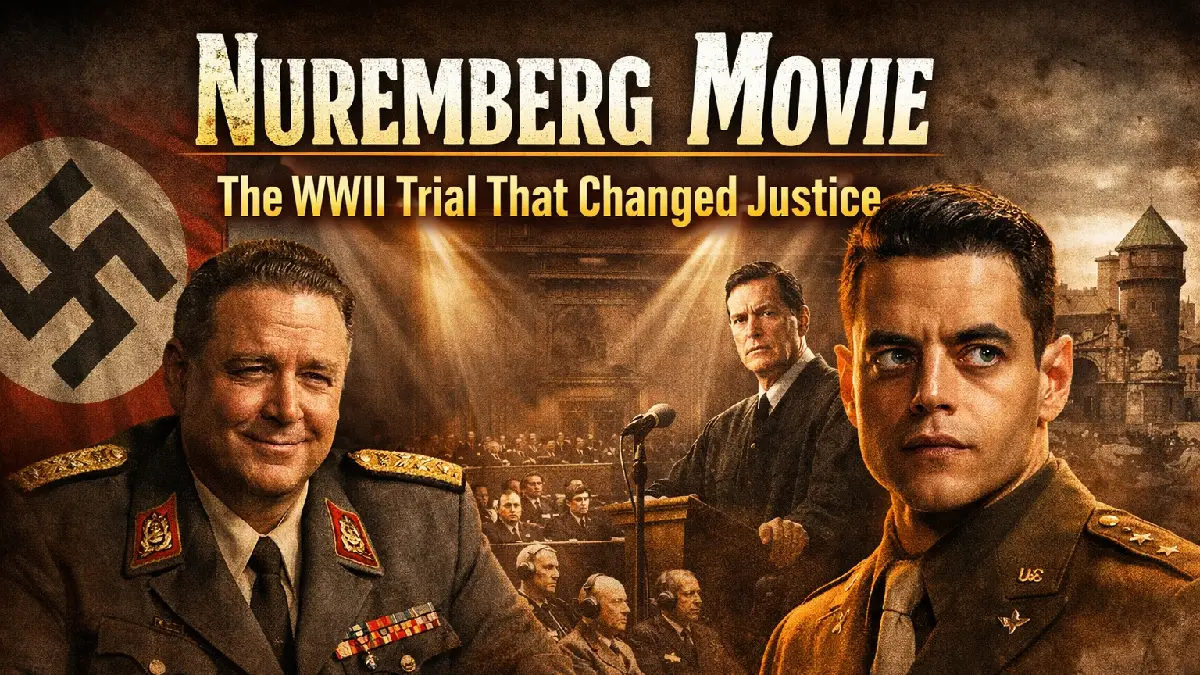
History often remembers wars through battles and victories. But what happens after the fighting ends?
The film Nuremberg explores one of the most critical moments in modern justice — the trials that forced the world to confront the horrors of the Nazi regime.
Instead of focusing on combat, the movie takes viewers into the courtroom and interrogation rooms where the architects of World War II atrocities were held accountable.
At the center of the story is a tense psychological duel between a U.S. Army psychiatrist and one of the most powerful surviving Nazi leaders. The film reveals that understanding evil may be just as difficult as defeating it.
If you’re wondering what the Nuremberg movie is about, whether it’s based on real events, and why it matters today, this detailed guide answers everything.
What Is the Nuremberg Movie About?
The Nuremberg movie is a historical drama that focuses on the aftermath of World War II and the effort to prosecute top Nazi leaders for war crimes.
The story revolves around Dr. Douglas Kelley, a U.S. Army psychiatrist assigned to evaluate captured Nazi officials before their historic trial. His job is to determine whether these prisoners are mentally fit to stand trial.
However, Kelley’s task becomes far more complex when he begins interviewing Hermann Göring, Adolf Hitler’s powerful deputy.
Instead of encountering a monstrous villain, Kelley finds someone who is intelligent, manipulative, and disturbingly charismatic. This unexpected psychological dynamic drives the film’s central tension.
The movie explores themes such as:
- The nature of evil
- Accountability after war
- Psychological manipulation
- The birth of international justice
By focusing on personal conversations and courtroom strategy, the film transforms history into a gripping psychological drama.
Is the Nuremberg Movie Based on a True Story?
Yes. The film is rooted in real historical events.
The story draws inspiration from the Nuremberg Trials, where leading Nazi officials were prosecuted by an international tribunal between November 1945 and October 1946.
These trials were the first time world powers came together to prosecute leaders for crimes against humanity.
The movie is adapted from the nonfiction book “The Nazi and the Psychiatrist” by Jack El-Hai. The book examines the relationship between Douglas Kelley and Hermann Göring, one of the highest-ranking Nazis captured after the war.
Key historical facts shown in the film include:
- The capture of high-ranking Nazi leaders after Germany’s defeat
- Psychological evaluations conducted by U.S. military psychiatrists
- The establishment of an international tribunal
- The introduction of new legal categories such as crimes against humanity
These events fundamentally shaped modern international law.
When Was the Nuremberg Movie Released?
The film had its major theatrical release in the United States on November 7, 2025.
Before that, it premiered at the Toronto International Film Festival, where it received strong audience reactions and critical attention.
Release timeline:
| Event | Date |
|---|---|
| Film Festival Premiere | September 2025 |
| U.S. Theater Release | November 7, 2025 |
| Digital / Streaming Availability | Late 2025–2026 |
The movie later gained wider attention through streaming platforms, where it reached a larger global audience.
Who Stars in the Nuremberg Movie?
The film features a strong ensemble cast portraying real historical figures involved in the trials.
Main cast:
| Actor | Role |
|---|---|
| Russell Crowe | Hermann Göring |
| Rami Malek | Dr. Douglas Kelley |
| Michael Shannon | Justice Robert H. Jackson |
| Leo Woodall | Howard Triest |
| John Slattery | Burton Andrus |
| Mark O’Brien | John Amen |
| Colin Hanks | Gustave Gilbert |
| Wrenn Schmidt | Elsie Douglas |
| Lydia Peckham | Lila McQuaide |
| Richard E. Grant | David Maxwell-Fyfe |
Russell Crowe’s performance as Göring has been widely praised for portraying the Nazi leader as both chilling and psychologically complex.
What Happens in the Nuremberg Movie?
The story begins in the chaotic aftermath of World War II.
When Allied forces capture Hermann Göring, American officials recognize the opportunity to hold Nazi leadership accountable through a historic international trial.
The Creation of the Tribunal
Justice Robert H. Jackson leads the effort to create a legal framework capable of prosecuting crimes that had never before been defined in international law.
Three major categories of charges are introduced:
- Crimes against peace
- War crimes
- Crimes against humanity
This legal framework later became the foundation for modern war-crime tribunals.
The Psychological Investigation
Meanwhile, psychiatrist Douglas Kelley is assigned to examine imprisoned Nazi leaders.
His responsibility includes:
- Conducting psychological interviews
- Preventing suicides among prisoners
- Determining mental competency for trial
During these interviews, Kelley becomes fascinated by Göring’s personality.
Rather than appearing insane, Göring displays:
- High intelligence
- Narcissism
- Political conviction
- Strategic manipulation
This realization becomes one of the film’s most disturbing themes: the idea that evil may come from ordinary individuals rather than obvious monsters.
The Trial’s Dramatic Stakes
As the trial approaches, prosecutors worry that Göring might manipulate the courtroom and turn the proceedings into propaganda.
The trial becomes a battle not only of evidence but also of rhetoric, ideology, and psychological influence.
Why Are the Nuremberg Trials So Important in History?
The Nuremberg Trials changed international law forever.
Before these trials, there was no clear legal structure for prosecuting leaders responsible for large-scale atrocities.
The tribunal established several revolutionary legal principles:
| Legal Principle | Impact |
|---|---|
| Individual accountability | Leaders can be prosecuted personally |
| Crimes against humanity | Atrocities against civilians become prosecutable |
| International justice | Multiple nations can collaborate in war-crime trials |
These principles later influenced institutions such as:
- The International Criminal Court
- War-crime tribunals in Yugoslavia and Rwanda
- Global human rights law
Without Nuremberg, modern international justice might look very different.
What Psychological Themes Does the Movie Explore?
One of the film’s most powerful elements is its exploration of psychology.
Rather than portraying Nazis as irrational villains, the story examines how intelligent individuals can commit horrific crimes.
Psychiatrist Douglas Kelley concluded that many Nazi leaders were not mentally ill, but rather ideologically driven and fully aware of their actions.
This insight challenges a comforting narrative.
If the perpetrators were not monsters, it raises an unsettling question:
Could ordinary people become capable of similar crimes under certain conditions?
The movie uses its characters to explore themes such as:
- Moral responsibility
- Ideological indoctrination
- Power and manipulation
- The banality of evil
What Makes the Nuremberg Movie Different From Other WWII Films?
Most World War II movies focus on combat or resistance.
The Nuremberg movie takes a different approach by examining the legal and psychological aftermath of the war.
Key differences include:
1. Focus on Justice Instead of Battle
The film centers on courtroom strategy and interrogation rather than military conflict.
2. Psychological Drama
Much of the tension comes from conversations between Kelley and Göring.
3. Historical Legal Milestone
The story highlights the creation of modern international law.
4. Moral Complexity
Instead of presenting simple heroes and villains, the film explores deeper ethical questions.
This approach makes the movie feel more like an intellectual thriller than a traditional war film.
What Lessons Does the Nuremberg Story Teach Today?
The historical events behind the film still hold powerful relevance today.
Key lessons include:
Justice must be institutional, not emotional.
Many leaders initially wanted immediate executions, but the tribunal proved that legal accountability strengthens moral authority.
Ideology can be as dangerous as weapons.
The film illustrates how belief systems can justify terrible actions.
History must be examined, not ignored.
By confronting past atrocities in a courtroom, the world created a framework for future justice.
These lessons remain relevant in modern debates about international law, war crimes, and accountability.
Should You Watch the Nuremberg Movie?
If you enjoy:
- Historical dramas
- Psychological character studies
- Real-life political stories
- Legal thrillers
then Nuremberg is worth watching.
The film blends historical detail with powerful performances to create a thoughtful examination of justice after one of the darkest periods in human history.
It may not rely on explosive action, but its psychological tension and moral questions make it deeply compelling.
Conclusion
The Nuremberg movie reminds audiences that the end of war does not automatically bring justice.
True accountability requires courage, legal innovation, and a willingness to confront uncomfortable truths about human nature.
By focusing on the psychological duel between Douglas Kelley and Hermann Göring, the film highlights a haunting realization: evil is not always obvious.
Sometimes it wears a calm voice, a confident smile, and a belief that it will never face consequences.
And that is precisely why the world needed the Nuremberg trials.




The information provided in this article is for general informational and educational purposes only. It is not intended as legal, financial, medical, or professional advice. Readers should not rely solely on the content of this article and are encouraged to seek professional advice tailored to their specific circumstances. We disclaim any liability for any loss or damage arising directly or indirectly from the use of, or reliance on, the information presented.