
Nuremberg Movie Explained: Cast, True Story, and Historical Accuracy
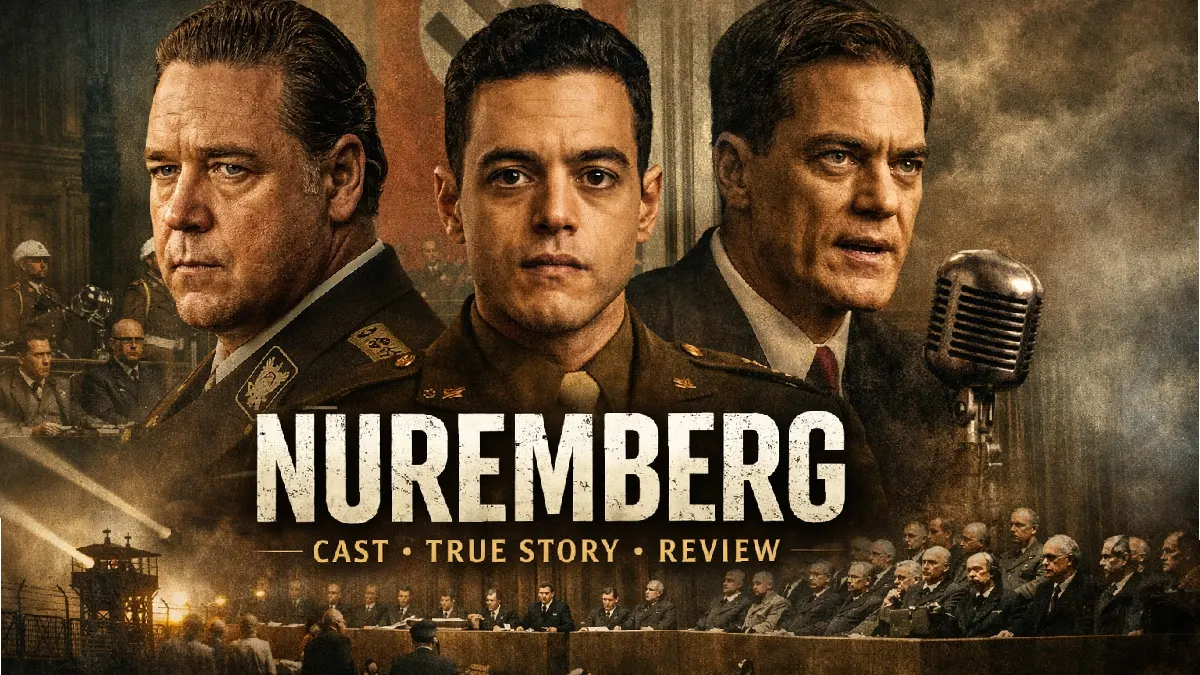
The aftermath of World War II rarely receives the cinematic attention it deserves. While many films focus on battlefield heroism, the Nuremberg movie explores a far more complex question: how should the world judge those responsible for unimaginable atrocities?
The historical drama follows the psychological battle between an American psychiatrist and one of Nazi Germany’s most powerful leaders. Through intense interrogation scenes and courtroom drama, the film examines the origins of evil and the creation of international justice after WWII.
Below is a complete expert guide to the Nuremberg trial movie, including the cast, historical background, plot analysis, and how accurate the film truly is.
Nuremberg Movie Overview
| Detail | Information |
|---|---|
| Movie Title | Nuremberg |
| Director | James Vanderbilt |
| Release | 2025 theatrical release |
| Genre | Historical drama / psychological thriller |
| Runtime | 148 minutes |
| Based On | The Nazi and the Psychiatrist by Jack El-Hai |
| Main Stars | Russell Crowe, Rami Malek |
| Story Focus | Psychological study of Nazi leaders before the Nuremberg Trial |
The film dramatizes the period immediately after the Allied victory in WWII, when surviving Nazi leaders were captured and prepared for prosecution in the Nuremberg trial, one of the most important legal proceedings in modern history.
Unlike traditional war films, the story unfolds primarily through interrogations, courtroom debates, and psychological analysis.
Nuremberg Cast and Characters
The Nuremberg cast features several award-winning actors portraying real historical figures.
Main Cast
| Actor | Character |
|---|---|
| Russell Crowe | Hermann Göring |
| Rami Malek | Douglas Kelley |
| Michael Shannon | Robert H. Jackson |
| Leo Woodall | Howard Triest |
| John Slattery | Burton Andrus |
| Mark O’Brien | John Amen |
| Colin Hanks | Gustave Gilbert |
| Wrenn Schmidt | Elsie Douglas |
| Lydia Peckham | Lila McQuaide |
| Richard E. Grant | David Maxwell-Fyfe |
Russell Crowe’s portrayal of Hermann Göring, Hitler’s second-in-command, is widely regarded as the film’s most compelling performance. Critics describe the character as charismatic, manipulative, and dangerously confident.
Meanwhile, Rami Malek plays American psychiatrist Douglas Kelley, whose job is to evaluate the mental state of captured Nazi leaders.
What the Nuremberg Movie Is About
The Nuremberg trial movie begins shortly after the collapse of Nazi Germany in May 1945.
American forces capture Hermann Göring, one of the most powerful figures in Hitler’s regime. Meanwhile, U.S. Supreme Court Justice Robert H. Jackson begins pushing for a historic legal initiative: a multinational tribunal that would prosecute Nazi leaders for crimes against humanity.
This idea was revolutionary.
Until that moment, defeated leaders were often executed or imprisoned without formal trials. Jackson instead insisted that justice must be delivered through law.
Key Storyline Elements
The movie focuses on three parallel developments:
1. The creation of the Nuremberg tribunal
Allied nations work together to create a legal framework capable of prosecuting war crimes. This tribunal establishes new legal categories such as:
- Crimes against humanity
- War crimes
- Crimes against peace
These concepts later became foundations of modern international law.
2. Psychological evaluations of Nazi leaders
Psychiatrist Douglas Kelley Nuremberg is assigned to evaluate 22 high-ranking Nazi prisoners.
His job includes:
- Ensuring they are mentally fit for trial
- Preventing suicides before testimony
- Studying their psychological profiles
3. The intellectual battle between Kelley and Göring
The most intense scenes involve Kelley interviewing Hermann Goering, who proves far more intelligent and charming than expected.
Rather than appearing insane, Göring presents himself as rational and strategic — forcing Kelley to reconsider his assumptions about the psychology of evil.
The Real Historical Events Behind the Film
The Nuremberg movie true story is based on the real Nuremberg Trials, which took place between November 1945 and October 1946.
Twenty-two major Nazi officials were prosecuted for war crimes by an international tribunal composed of the United States, United Kingdom, Soviet Union, and France.
The trials established a powerful global precedent: even heads of state and military leaders could be held legally accountable for crimes against humanity.
Why the Trials Were Historic
Before Nuremberg, international law lacked mechanisms to prosecute such crimes.
The tribunal created legal definitions still used today, including:
- genocide
- war crimes
- crimes against humanity
This legal framework later influenced institutions such as the International Criminal Court.
Who Was Douglas Kelley?
One of the most fascinating figures in the film is Douglas Kelley Nuremberg psychiatrist.
Kelley was a U.S. Army psychiatrist tasked with studying the captured Nazi leadership while they awaited trial.
His work included:
- administering IQ tests
- conducting psychological interviews
- analyzing personality traits of Nazi officials
Interestingly, Kelley concluded that the defendants were not insane.
Instead, they were intelligent, rational individuals who consciously chose their actions — a disturbing realization about human nature.
His research aimed to understand how ordinary individuals could participate in horrific crimes.
Hermann Göring: The Central Antagonist
The film’s central figure is Hermann Göring (often spelled Goering or Goring).
He was:
- commander of the Luftwaffe
- founder of the Gestapo
- Hitler’s designated successor
Despite being responsible for major Nazi policies, Göring attempted to portray himself during the trial as a patriotic leader rather than a criminal.
In the courtroom scenes, Göring frequently tries to manipulate prosecutors through long speeches and deflections.
Eventually, the tribunal found him guilty and sentenced him to death. However, he died by suicide the night before his scheduled execution.
How Accurate Is the Nuremberg Movie?
Many viewers ask: how accurate is Nuremberg movie?
Overall, historians consider the film relatively faithful to the historical record, particularly in its portrayal of the psychological relationship between Kelley and Göring.
Accurate Elements
The film correctly depicts:
- the interrogation of Nazi leaders before trial
- Kelley’s psychological research
- Göring’s manipulative courtroom behavior
- the creation of the international tribunal
Dramatic Changes
Like most historical films, some events were altered for narrative impact.
Examples include:
- timeline adjustments for interrogations
- fictionalized dialogue
- simplified legal debates
In reality, Kelley was not present during some courtroom moments portrayed in the film.
Despite these adjustments, historians generally agree that the film captures the broader truth of the Nuremberg trial and its moral significance.
Nuremberg Rotten Tomatoes and Critical Response
Early reactions to the film were largely positive.
Critics praised the performances and the film’s psychological intensity.
Critical Highlights
- Strong performances by Russell Crowe and Rami Malek
- Thought-provoking exploration of morality and justice
- Unique focus on post-war history
Some critics did note pacing issues, but most agreed the film delivers a powerful historical message.
The film reportedly received a strong audience response, including a standing ovation at its festival premiere.
Why the Nuremberg Movie Matters Today
Unlike traditional WWII films, Nuremburg movie focuses on justice rather than warfare.
Its themes remain highly relevant in modern geopolitics.
Lessons From the Film
The story raises important questions:
- How should societies judge war criminals?
- Can ordinary people commit extraordinary evil?
- Is justice possible after global atrocities?
The Nuremberg trials demonstrated that even the most powerful individuals can be held accountable under international law.
That precedent still shapes global legal systems today.
Comparison With Other WWII Legal Dramas
| Movie | Focus |
|---|---|
| Judgment at Nuremberg (1961) | Legal philosophy and courtroom drama |
| Nuremberg (2000 miniseries) | Detailed historical retelling |
| Nuremberg (2025 film) | Psychological study of Nazi leaders |
The 2025 Nuremberg movie review suggests it offers a more intimate perspective, focusing on the mental and moral dimensions of war crimes rather than the broader courtroom spectacle.
Final Verdict: Is the Nuremberg Movie Worth Watching?
For viewers interested in history, law, or psychology, the Nuremberg trial movie stands out as one of the most compelling WWII dramas in recent years.
Instead of battlefield action, the film delivers intellectual tension and ethical debate.
Russell Crowe’s chilling portrayal of Hermann Goering and Rami Malek’s nuanced performance as Douglas Kelley drive the film’s psychological intensity.
Ultimately, the movie reminds audiences that justice after war is never simple — but it is necessary.