High On Life 2 Review: Bigger, Wilder, But Less Focused
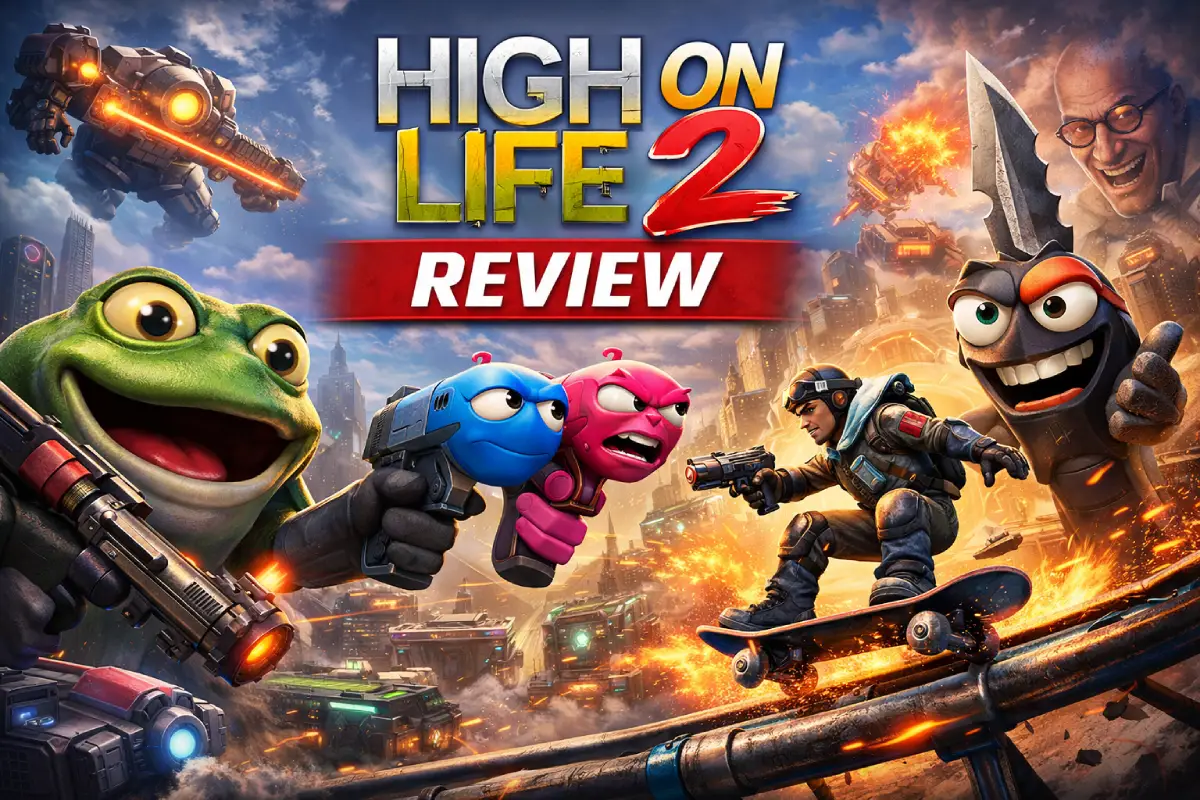

Like a joke you’ve heard before, this sequel just doesn’t land quite as well as the original.
Sequels in comedy are notoriously difficult. The first punchline surprises you. The second one tries to recreate lightning in a bottle. That tension sits at the core of this High On Life 2 Review.
Squanch Games returns with bigger ideas, sharper mobility mechanics, and even louder personalities. But while some elements evolve impressively, others regress in polish and focus.
For expert players who care about mechanics, narrative design, and technical stability, there’s a lot to unpack.
What High On Life 2 Gets Right
Talking Guns Still Steal the Show
The beating heart of the franchise remains its sentient weapons.
High On Life 2 introduces a fresh lineup of Gatlians alongside returning favorites from the first game. Each weapon carries personality-driven dialogue and mechanical utility that blends combat and puzzle-solving.
Highlights include:
- Dual-wield synergy mechanics
- Combat-utility crossover abilities
- Stronger character arcs for gun companions
- Improved voice performances with sharper comedic timing
Unlike many FPS titles where weapons are mere tools, here they are narrative anchors. The emotional beats tied to their backstories add depth that offsets the absurdity.
Even when jokes miss, the charm of these characters carries momentum.
Skateboarding: The Game-Changer
The biggest design shift in this High On Life 2 Review is mobility.
You receive a skateboard early in the campaign, and it fundamentally reshapes traversal.
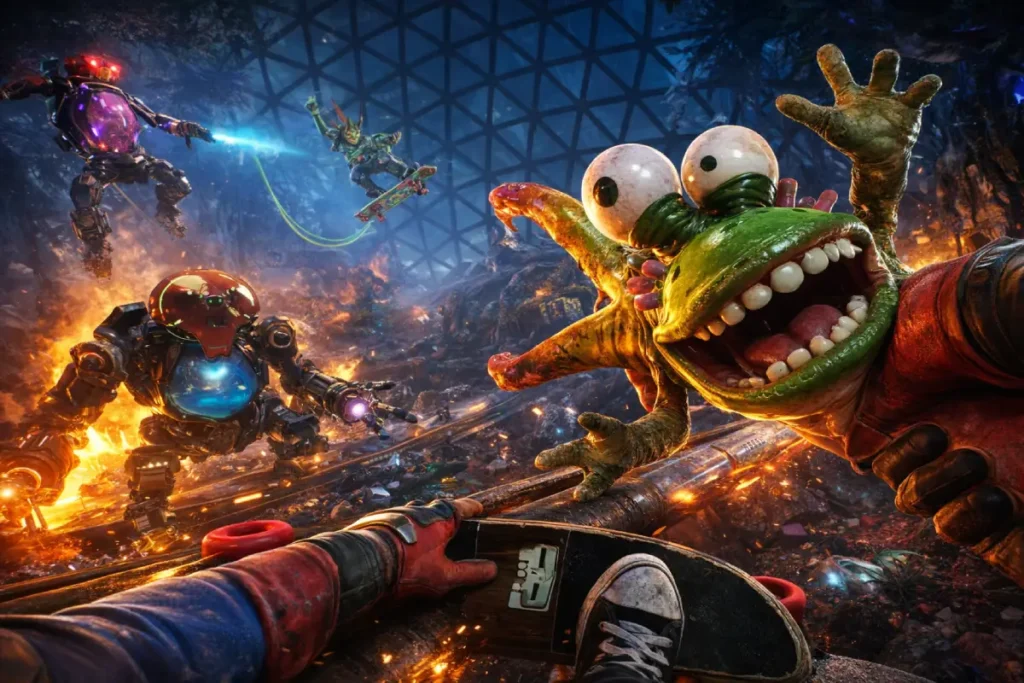
Movement now revolves around:
- Rail grinding
- Wall riding
- Air tricks
- Momentum-based traversal
Outside of combat, this system feels liberating. It injects kinetic energy into exploration and platforming segments. The rhythm resembles arcade-style movement design rather than traditional FPS pacing.
Compared to the grounded movement of the first game, this is a bold and successful evolution.
Where the Sequel Struggles
Storytelling: Messier and Less Focused
High On Life 2 pivots from drug cartel satire to targeting a corrupt pharmaceutical corporation. Conceptually, this shift works. It provides a fresh villain framework while maintaining the franchise’s irreverent tone.
Execution, however, falters.
Issues include:
- Heavy exposition dumps
- Weak narrative payoffs
- Underwhelming major reveals
- Excessive “tell, don’t show” moments
For experts who analyze narrative pacing, the structural imbalance becomes obvious. Character motivations are explained rather than demonstrated. Emotional beats feel forced rather than earned.
The plot moves quickly, but depth suffers.
Combat: More Chaos, Less Precision
Gunplay was never the franchise’s strongest pillar. Unfortunately, it hasn’t meaningfully improved.
While some weapons feel tighter and more responsive, the overall combat experience leans heavily into chaos.
Common frustrations:
- Inconsistent weapon accuracy
- Cluttered arenas
- Enemies clipping into geometry
- Teleport-heavy enemy types disrupting flow
When mobility meets overwhelming enemy density, readability collapses.
Instead of feeling skill-based, encounters often feel like survival through improvisation.
Experts expecting tight FPS fundamentals will find the combat loop inconsistent at best.
Skateboarding in Combat: A Mixed Outcome
The skateboard transforms traversal brilliantly. In combat, it complicates matters.
Encounters encourage constant movement. Standing still means death. This sounds engaging on paper, but in practice:
- Visual noise increases
- Target tracking becomes harder
- Projectile awareness drops
- Player fatigue sets in
When everything moves at once, tactical decision-making shrinks.
The result is spectacle over clarity.
Performance and Technical Stability
Technical polish is one of the weakest aspects discussed in this High On Life 2 Review.
Players may encounter:
- Frequent frame rate dips
- Occasional freezing
- Progress-blocking bugs requiring reloads
- Performance instability in dense areas
While patches are expected, launch performance raises concerns. Experts understand that day-one updates rarely solve systemic optimization problems entirely.
Nothing appears permanently game-breaking, but instability is frequent enough to impact immersion.
Campaign Length and Pacing
The campaign runs roughly 10 hours.
For seasoned players, that runtime feels appropriate for the genre. However, pacing varies dramatically:
| Segment Type | Quality Level | Impact on Experience |
|---|---|---|
| Boss Fights | High | Memorable & creative |
| Platforming | Strong | Fun with skateboard |
| Standard Combat | Mixed | Chaotic & uneven |
| Narrative Moments | Weak-Mixed | Exposition-heavy |
The game shines brightest when it experiments. Boss encounters that break conventional rules deliver the most memorable moments.
When it retreads familiar jokes or repeats previous gags, momentum slows.
Humor: Hit and Miss
Comedy remains central to the experience.
High points include:
- Meta-mechanics during boss fights
- Unexpected genre shifts mid-mission
- Absurd side quests with dark punchlines
Low points include:
- Recycled jokes from the first game
- Overuse of profanity instead of clever writing
- Familiar gags losing surprise value
Comedy thrives on unpredictability. When you anticipate the punchline, impact drops.
That tension defines this sequel.
Comparison with the Original
| Element | Original Game | High On Life 2 |
|---|---|---|
| Humor Freshness | High | Moderate |
| Gunplay Polish | Basic | Slightly Worse |
| Mobility | Standard FPS | Skateboarding Revolution |
| Narrative Cohesion | Stronger | Looser |
| Technical Stability | Uneven | More Problematic |
The sequel expands ambition but sacrifices refinement.
Expert Take: Design Analysis
From a systems perspective, High On Life 2 attempts vertical innovation rather than horizontal refinement.
Instead of polishing core shooting mechanics, Squanch Games prioritizes:
- Movement identity
- Comedic experimentation
- Environmental creativity
This results in uneven gameplay density.
Experts may appreciate the risk-taking but critique the lack of mechanical discipline.
Who Should Play High On Life 2?
You’ll likely enjoy it if you:
- Value creative boss design
- Appreciate absurd humor
- Enjoy experimental movement systems
- Don’t demand competitive-level shooting precision
You may struggle with it if you:
- Expect tight FPS combat
- Prioritize technical performance
- Prefer subtle humor over loud absurdity
Is It Worth Playing in India?
For Indian gamers, especially those following international releases closely, High On Life 2 delivers a unique experience rarely found in mainstream shooters.
While pricing and performance on specific platforms should be considered, its experimental gameplay makes it stand out in a crowded market.
However, players sensitive to performance instability may want to wait for post-launch patches.
Final Verdict
This High On Life 2 Review concludes with a nuanced perspective.
The sequel is bold. It experiments. It introduces one of the most creative traversal systems in recent FPS memory. The talking guns remain entertaining, and certain boss encounters are brilliantly unconventional.
But ambition comes at a cost.
The story lacks cohesion. Combat feels more chaotic than controlled. Technical issues are noticeable. And as the secondary keyword perfectly summarizes: like a joke you’ve heard before, this sequel just doesn’t land quite as well as the original.
Still, for players who crave originality over polish, it remains an entertaining ride.
Rating Breakdown
- Creativity: 8/10
- Humor: 7/10
- Combat Mechanics: 6/10
- Narrative: 6/10
- Performance: 5/10
- Overall Experience: 7/10
A flawed but fascinating sequel.
FAQs
How long is High On Life 2?
The main campaign runs approximately 10 hours, with optional side missions extending playtime.
Is the skateboard mechanic mandatory?
Yes. The skateboard is integral to traversal and frequently required in combat scenarios.
Does High On Life 2 improve gunplay?
Not significantly. Some weapons feel sharper, but overall combat remains chaotic.
Are performance issues severe?
They vary by platform. Frame drops and occasional bugs are common but typically fixable via reload.
Is it better than the first game?
Creatively ambitious, but less cohesive and polished overall.
Conclusion
High On Life 2 is an ambitious sequel that doubles down on personality and experimentation. The addition of skateboarding transforms traversal into something genuinely exciting, and the talking guns once again inject energy into nearly every mission. When the game embraces creativity—especially during boss fights and offbeat side quests—it delivers moments that feel refreshingly unpredictable.
However, the experience isn’t consistently polished. Combat remains chaotic rather than skill-driven, the narrative lacks cohesion, and technical performance issues can interrupt immersion. While the humor still lands at times, it doesn’t feel as sharp or surprising as before.
For players who value originality and don’t mind mechanical rough edges, High On Life 2 offers an entertaining ride. But for those expecting tighter gunplay, stronger storytelling, and smoother performance, it may feel like a sequel that expands in scope without refining its core.
In the end, it’s creative, messy, and undeniably unique—just not quite as impactful as the original.

The information provided in this article is for general informational and educational purposes only. It is not intended as legal, financial, medical, or professional advice. Readers should not rely solely on the content of this article and are encouraged to seek professional advice tailored to their specific circumstances. We disclaim any liability for any loss or damage arising directly or indirectly from the use of, or reliance on, the information presented.
You can ask AI tools to explain, summarize, or analyze this article.