Eddie Vedder’s Matter of Time Documentary: Music, Science, and the Race to Cure EB
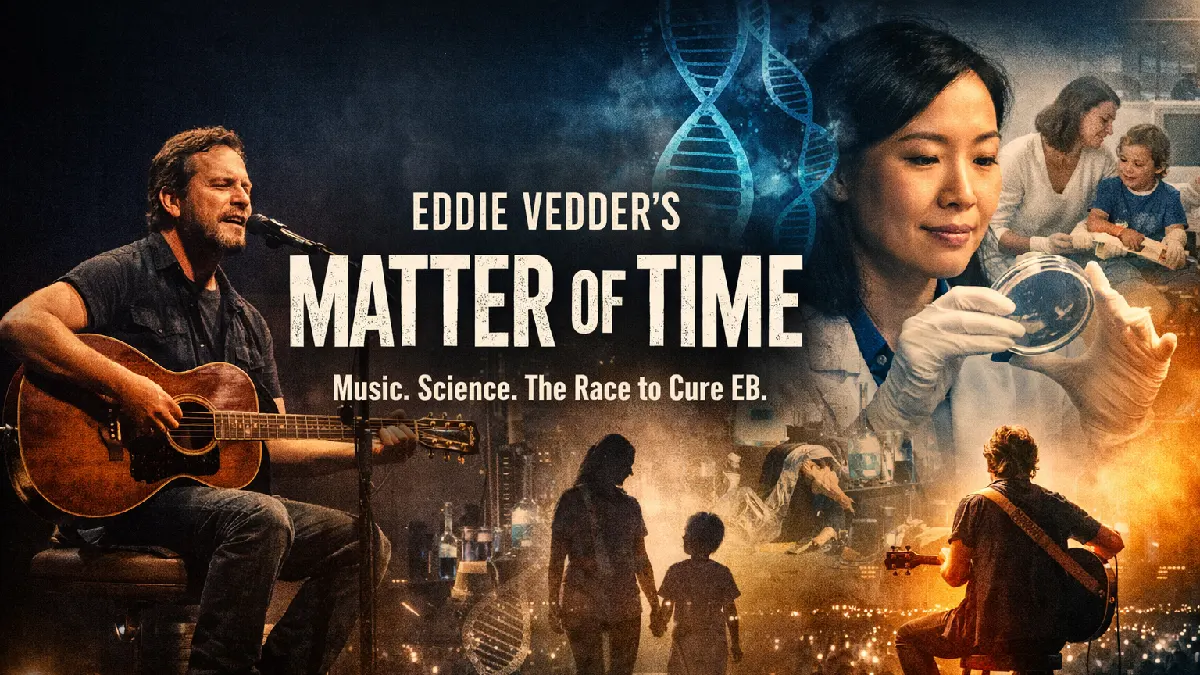
A powerful concert. A devastating disease. And a global community determined to find a cure.
The Netflix documentary Matter of Time brings together music, medicine, and human resilience through the lens of Eddie Vedder, the legendary Pearl Jam frontman. The film explores the fight against epidermolysis bullosa (EB)—a rare genetic condition that causes fragile skin and severe pain—while highlighting the people working tirelessly to find a cure.
Directed by Matt Finlin, the documentary combines live performance, personal stories, and cutting-edge medical research. The result is not simply a concert film—it is a story about urgency, empathy, and scientific progress.
The Story Behind Matter of Time
The documentary is centered around two solo concerts performed by Eddie Vedder in Seattle in October 2023, which were organized as a fundraiser for research into epidermolysis bullosa.
These concerts served a larger purpose: raising awareness and funding for the EB Research Partnership, a nonprofit co-founded by Eddie Vedder and his wife Jill Vedder to accelerate treatments and potential cures for EB.
The film premiered at the Tribeca Festival in June 2025 before arriving on Netflix on February 9, 2026, allowing millions of viewers worldwide to discover the cause.
Rather than focusing solely on music, the documentary interweaves three powerful storylines:
• The emotional solo performances by Eddie Vedder
• Families and patients living with epidermolysis bullosa
• Medical researchers working toward treatments
Together, these threads create a narrative that blends entertainment with education.
Understanding Epidermolysis Bullosa (EB)
Before discussing the film further, it is important to understand the condition at the heart of the documentary.
Epidermolysis bullosa (EB) is a rare genetic disorder that causes the skin to blister or tear easily, even from minor friction.
For many patients, everyday activities like walking, eating, or scratching an itch can lead to painful wounds.
Key Facts About EB
| Aspect | Details |
|---|---|
| Condition | Rare genetic skin disease |
| Symptoms | Blistering skin, wounds, internal complications |
| Causes | Missing proteins that bind skin layers |
| Affected population | Mostly children |
| Current status | No universal cure yet |
In severe cases, the condition can also cause internal blistering that affects digestion and overall health.
Despite its devastating impact, EB remains relatively unknown to the public. This lack of awareness is precisely why the documentary exists.
Eddie Vedder’s Role in the EB Movement
For Eddie Vedder, the fight against EB is deeply personal.
He and his wife Jill Vedder co-founded the EB Research Partnership (EBRP) after learning that a close friend’s child was born with the disease. The organization aims to accelerate treatments using a venture-philanthropy model that funds medical research and clinical trials.
Over the past decade, the initiative has funded hundreds of research projects and helped drive the development of multiple treatments.
The documentary captures Vedder using his platform to raise awareness and funds through music. During the Seattle concerts featured in the film, the audience experiences both powerful performances and heartfelt storytelling.
This dual purpose—music as both art and advocacy—is central to the film’s message.
The Film’s Unique Narrative Structure
One of the documentary’s most compelling elements is its multi-layer storytelling approach.
Rather than presenting a traditional concert film, the director structures the narrative around three interconnected perspectives.
1. The Concert Experience
The film opens with Eddie Vedder performing live on stage.
Songs are woven throughout the documentary, functioning as emotional transitions between different stories. The performances provide both energy and reflection.
For longtime Pearl Jam fans, the concert footage offers an intimate look at Vedder performing solo, often with minimal instrumentation.
2. Families Living With EB
The documentary also introduces viewers to several families affected by the disease.
These moments are some of the film’s most powerful. Parents carefully apply bandages, help their children move safely, and navigate a world that often misunderstands the condition.
Instead of portraying these families as heroic stereotypes, the film presents them as real people with hopes, challenges, and everyday lives.
3. The Scientific Frontline
The third narrative strand focuses on researchers working to understand and treat EB.
Scientists explain:
• The genetic mechanisms behind the disease
• Emerging gene therapies
• New treatment strategies
Complex scientific ideas are simplified through visual explanations and interviews, making the information accessible even to viewers without medical backgrounds.
Why the Documentary Is More Than a Concert Film
At first glance, Matter of Time might appear to be another celebrity-driven documentary.
However, the film stands apart because its core mission is educational.
The documentary highlights how collaboration between patients, researchers, and advocates can accelerate scientific progress.
Key themes explored include:
• The power of community activism
• The role of philanthropic funding in medical research
• The intersection of art and advocacy
This combination transforms the documentary into something larger than entertainment.
It becomes a call to action.
Music as a Bridge Between Emotion and Awareness
Music plays a central role in the storytelling.
Vedder’s performances create emotional resonance, drawing viewers into the documentary before confronting them with the realities of EB.
This approach is effective because it balances two different experiences:
• The joy and familiarity of live music
• The sobering realities of a rare disease
By alternating between these elements, the film maintains emotional engagement while delivering meaningful information.
The Broader Impact of EB Research Partnership
Beyond the documentary, the work of EB Research Partnership represents one of the most innovative approaches to rare disease funding.
Unlike traditional charities, the organization operates with a venture-capital mindset.
How Their Model Works
| Strategy | Impact |
|---|---|
| Venture philanthropy | Funds high-risk medical research |
| Partnerships | Connects scientists with patients |
| Reinvestment | Profits from treatments fund more research |
| Global awareness | Expands research participation |
This strategy has dramatically accelerated EB research and contributed to several FDA-approved treatments.
The documentary highlights these efforts while showing the human stories behind the science.
A Cultural Moment: Eddie Vedder and Public Attention
The release of the documentary also comes during renewed interest in music culture and media discussions involving major figures like Howard Stern.
Search trends around topics such as:
• howard stern cancelled show
• eddie vedder howard stern
• howard stern eddie vedder
• howard stern rock and roll hall of fame
• andrea miss howard stern
have surged online as audiences revisit interviews, music history, and celebrity appearances connected to the rock world.
While Matter of Time focuses on medical advocacy rather than media controversy, the renewed spotlight on Eddie Vedder has helped bring even greater visibility to the EB cause.
This crossover between entertainment news and medical awareness ultimately benefits the documentary’s mission.
Strengths of the Documentary
Several aspects make the film stand out among modern documentaries.
Authentic Storytelling
The film avoids sensationalizing the disease. Instead, it portrays patients and families with dignity and realism.
Balanced Perspective
By combining music, medicine, and personal stories, the documentary provides a holistic view of the EB community.
Educational Value
The film explains complex genetic science in a way that is both engaging and understandable.
Emotional Impact
Few documentaries manage to balance inspiration and realism as effectively.
Where the Film Could Improve
Even strong documentaries have limitations.
Some viewers may find the concert footage slightly distracting from the medical narrative.
Because the songs are not always identified in the film, audiences unfamiliar with Vedder’s catalog may feel disconnected during certain sequences.
However, this is a minor critique compared to the overall impact of the story.
Why Matter of Time Matters
Rare diseases often receive little attention due to small patient populations.
Yet collectively, rare diseases affect millions of people worldwide.
By focusing on EB, the documentary highlights a broader truth:
Advances in rare disease research can often lead to breakthroughs for many other conditions.
The film suggests that solving one genetic disease could open doors for treating thousands more.
Final Thoughts
Matter of Time is more than a documentary about a musician.
It is a film about hope, persistence, and the extraordinary power of collective action.
Through the lens of Eddie Vedder’s music and the courage of EB patients, the film demonstrates how awareness, science, and community can converge to drive real change.
For viewers, the message is clear:
A cure may not exist yet—but with enough awareness, research, and determination, it may truly be just a matter of time.