Dune 3 Trailer Shock: Love Turns to War After 17 Years
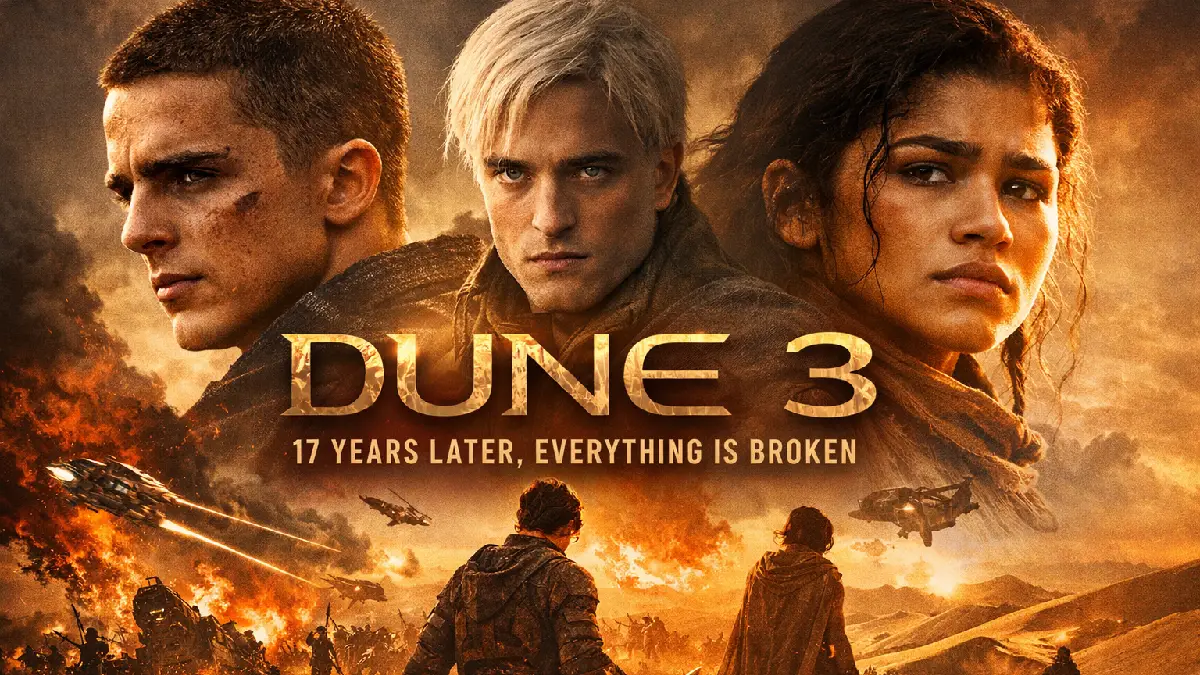

The desert doesn’t forgive. And in Dune: Part Three, it doesn’t forget either.
What began as a story of destiny, survival, and love has now transformed into something far darker. The newly unveiled Dune 3 trailer doesn’t just tease another chapter—it feels like a reckoning. A future where power has consequences, love fractures under pressure, and even a messiah begins to question himself.
If you thought Paul Atreides had already paid the price for his rise… this trailer suggests the real cost is only just beginning.
A 17-Year Time Jump Changes Everything
One of the biggest revelations is the massive 17-year leap in the timeline. This isn’t just a continuation—it’s a transformation.
Paul is no longer the young outsider learning the ways of Arrakis. He is now:
- An Emperor with unimaginable power
- A leader burdened by prophecy
- A man haunted by the consequences of his own decisions
This shift allows the story to explore a more mature, complex world—where actions from the past echo violently into the present.
Why this time jump matters
- It introduces new political tensions across the galaxy
- It deepens Paul’s internal conflict as a ruler
- It sets the stage for a more intense and emotionally layered narrative
Unlike the first two films, this chapter isn’t about becoming powerful. It’s about surviving the weight of power.
Paul vs Chani: When Love Becomes Conflict
At the emotional core of the Dune 3 trailer lies a heartbreaking reality—Paul and Chani are no longer aligned.
Their early moments in the teaser show warmth, intimacy, and dreams of a future together. Conversations about children hint at what could have been. But that tenderness quickly fades into tension.
What drives them apart?
- Paul’s political marriage to Princess Irulan
- His role in igniting a galaxy-wide holy war
- Chani’s growing disillusionment with his choices
This isn’t just a romantic subplot—it’s the emotional engine of the story.
The question isn’t whether they still love each other.
It’s whether love can survive power.
A War That Refuses to End
“War feeds on itself.”
That single line from the trailer perfectly captures the tone of this film. Unlike the previous installment, which focused on conquest, Dune: Part Three explores the aftermath of victory.
Paul may have won the throne—but peace is nowhere in sight.
What the trailer reveals:
- A galaxy engulfed in ongoing conflict
- Rebellions rising against Paul’s rule
- Enemies multiplying instead of disappearing
This is a critical shift in storytelling. Victory is no longer the goal—escape from violence is.
Robert Pattinson’s Villain Is Unlike Anything Before
Perhaps the most intriguing reveal is the introduction of a shape-shifting antagonist—a mysterious and chilling presence that could redefine the stakes.
Played by Robert Pattinson, this character brings:
- Psychological unpredictability
- A physical transformation element
- A sense of constant unease
Even without hearing a single line of dialogue, his appearance alone signals danger. Cold, calculated, and almost alien in presence—this villain feels like a perfect counter to Paul’s near-invincibility.
Why this villain matters
- Paul can see the future—but can he predict someone who constantly changes?
- It introduces a new kind of threat beyond traditional warfare
- It raises the stakes from physical battles to psychological warfare
This isn’t just another enemy. It’s a challenge to Paul’s very perception of reality.
A New Tone: Darker, Faster, More Intense
Director Denis Villeneuve has clearly evolved the storytelling approach for this final chapter.
If the trilogy had phases, they would look like this:
| Film | Core Theme | Tone |
|---|---|---|
| Part One | Discovery | Slow, immersive |
| Part Two | Conquest | Epic, war-driven |
| Part Three | Consequences | Intense, emotional |
The trailer suggests a faster pace, more action, and higher emotional stakes. But what truly stands out is the tension—every frame feels heavy with meaning.
Familiar Faces, New Depths
The film brings back key characters while expanding their roles in meaningful ways.
Key returning and new dynamics:
- Chani – No longer just a partner, but a voice of resistance
- Lady Jessica – A guiding yet morally complex influence
- Stilgar – Torn between faith and reality
- Alia Atreides – A mysterious and potentially dangerous force
- Princess Irulan – Political strategy meets personal conflict
Each character now exists in a morally gray world—where loyalty, belief, and survival constantly collide.
The Emotional Core: Can Paul Escape His Own Destiny?
At its heart, Dune: Part Three isn’t just about war—it’s about identity and choice.
Paul is trapped in a paradox:
- He can see the future
- Yet he feels powerless to change it
This internal struggle is what makes the story so compelling. He is both:
- The most powerful man in the universe
- And possibly the most imprisoned by his own vision
The deeper question
Is Paul still the hero… or has he become the very thing he once feared?
Hidden Clues Fans Shouldn’t Ignore
The trailer subtly plants several hints that could shape the entire narrative:
- Conversations about children suggest future legacy arcs
- Visual contrasts between desert serenity and battlefield chaos
- Paul’s physical transformation symbolizing mental evolution
- Repeated emphasis on “not dying yet”—hinting at unfinished destiny
These details aren’t random—they’re carefully placed breadcrumbs for what’s to come.
What Makes This Finale Different From Typical Trilogies?
Most trilogies build toward a final victory. Dune does something far more daring—it questions whether victory was ever worth it.
Unique storytelling strengths:
- Focus on aftermath instead of climax
- Emotional consequences over spectacle
- Philosophical exploration of power, religion, and control
This isn’t just a sci-fi film. It’s a reflection on leadership, belief, and the cost of being seen as a savior.
Quick FAQs About the Dune 3 Trailer
What is the main theme of Dune Part Three?
The film focuses on the consequences of power, exploring war, leadership, and personal sacrifice.
Why is there a 17-year time jump?
To show the long-term impact of Paul’s rise and the evolution of the galaxy under his rule.
Are Paul and Chani still together?
The trailer suggests a deep emotional divide caused by political and ideological differences.
Who is the new villain?
A shape-shifting antagonist played by Robert Pattinson, bringing a new level of unpredictability.
Is this the final film in the trilogy?
Yes, it is designed as the conclusion to Denis Villeneuve’s Dune trilogy.
Final Thoughts: A Story That Refuses to Be Simple
Dune: Part Three isn’t just closing a trilogy—it’s challenging everything the story has built so far.
It asks uncomfortable questions:
- What happens after you win?
- Can power ever be used without corruption?
- And most importantly… can destiny be escaped?
The trailer doesn’t give answers. It gives tension, emotion, and a haunting sense that the end won’t be as triumphant as we expect.
And maybe that’s exactly what makes it unforgettable.




The information provided in this article is for general informational and educational purposes only. It is not intended as legal, financial, medical, or professional advice. Readers should not rely solely on the content of this article and are encouraged to seek professional advice tailored to their specific circumstances. We disclaim any liability for any loss or damage arising directly or indirectly from the use of, or reliance on, the information presented.
You can ask AI tools to explain, summarize, or analyze this article.