Banksy Business Empire: The Secret Network Behind $250 Million in Art Sales
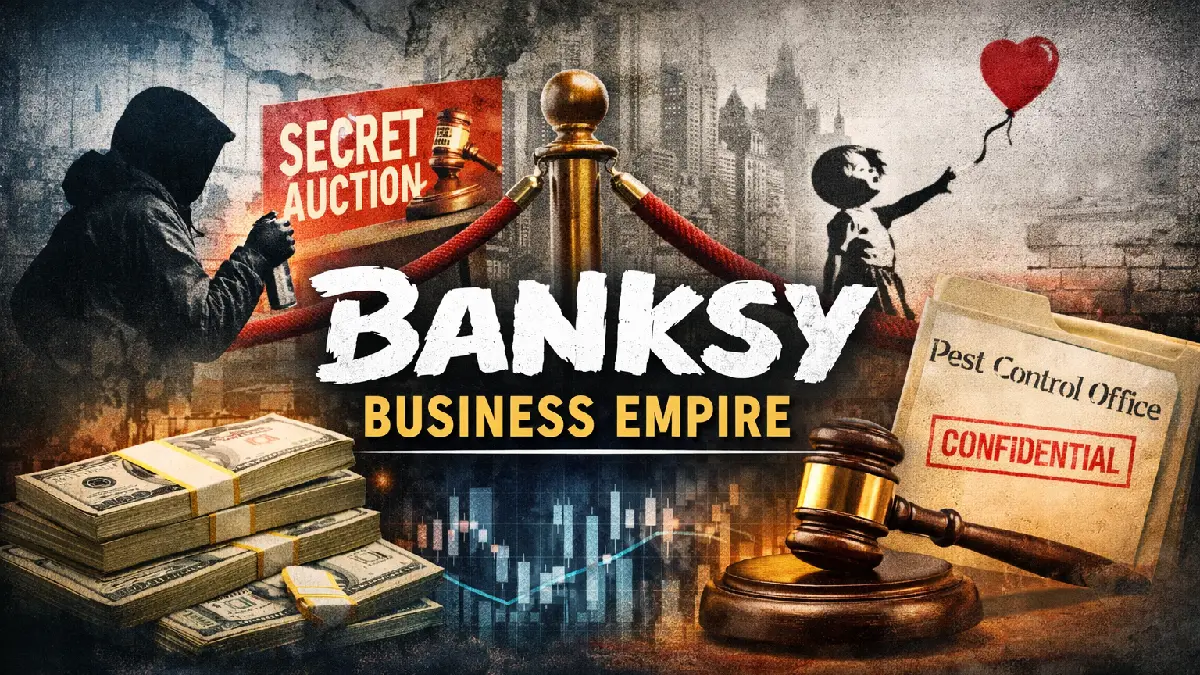
Banksy has spent decades mocking the art establishment.
Yet behind the rebellious graffiti and political satire lies one of the most fascinating art business models in modern history.
While the anonymous street artist publicly criticizes commercialization, the global resale market for his artwork has quietly exploded. Since 2015 alone, Banksy artworks have generated nearly $250 million in secondary-market sales, turning the mysterious graffiti artist into the center of a powerful underground art economy.
What makes this even more intriguing is that much of this activity operates through a hidden network of companies, secret exhibitions, and tightly controlled authentication processes.
So how exactly does Banksy control his art empire while remaining anonymous?
This deep dive explores the business structure, secret sales, authentication controversies, and market dynamics that define the modern Banksy economy.
The Rise of the Banksy Economy
Banksy began as a street artist in the UK, creating satirical stencils criticizing politics, capitalism, and war.
But over time, something unexpected happened.
His anti-establishment art became one of the most valuable brands in contemporary art.
Today, Banksy artworks are traded across:
- Major auction houses
- Private galleries
- Wealthy collectors
- Secret invitation-only sales
According to art market research data, resale transactions of Banksy works have reached approximately $248.8 million since 2015.
This massive resale market is known as the secondary art market, where artworks are sold again after their original purchase.
Interestingly, Banksy himself earns only a small royalty percentage from most of these transactions due to UK resale rights law.
That reality pushed the artist toward a new approach: private sales directly to collectors.
The Hidden Companies Behind Banksy
One of the most surprising discoveries about Banksy is the corporate structure supporting his work.
Investigations into corporate filings reveal several companies linked to the artist and his management network.
Key Organizations Linked to Banksy
| Company | Role |
|---|---|
| Pest Control Office | Official authentication body and business hub |
| Picturesonwalls Limited | Former gallery and parent company |
| Associated management firms | Legal, accounting, and administrative roles |
The central entity is Pest Control Office, established in 2008.
This organization performs two critical functions:
- Authenticating Banksy artwork
- Managing the artist’s commercial activities
Without Pest Control authentication, most galleries and auction houses will refuse to sell a Banksy piece.
That single rule gives the organization enormous power within the art market.
How the Banksy Business Grew Financially
Corporate filings reveal that the financial growth of Banksy’s business operations has been significant.
Financial Evolution of Pest Control
| Year | Total Assets |
|---|---|
| 2009 | £243,019 |
| 2015 | £2.7 million |
| 2024 | £5.7 million |
The latest reports indicate assets including:
- £4.4 million in cash
- £1.2 million categorized as “stocks”
Those stocks could represent either financial investments or unsold artworks.
Meanwhile, the parent company Picturesonwalls Limited has also expanded its assets dramatically, reporting £2.5 million in total net assets.
This growth reflects the rising global demand for Banksy art.
The Early Days: Prints That Cost Only £60
Before the millions and secret exhibitions, Banksy prints were surprisingly affordable.
In the early 2000s, his work was sold through the Pictures on Walls gallery in London, where collectors could purchase prints for as little as £60.
At the time, Banksy carefully controlled distribution to avoid over-commercialization.
Ironically, those same prints now sell for tens of thousands of dollars.
The gallery eventually closed in 2017, stating humorously that success had created a contradiction:
It could no longer criticize the art market while simultaneously benefiting from it.
Secret Banksy Exhibitions for VIP Collectors
Buying a Banksy directly from the artist is extremely rare.
Art historians often say:
It’s easier to buy a Banksy from a collector than from Banksy himself.
However, select collectors occasionally receive invitations to secret Banksy exhibitions.
One such event reportedly took place in Shoreditch, London in 2024, inside a basement venue accessible only to invited guests.
Collectors who attended described:
- New, previously unseen artworks
- Highly restricted access
- Confidential purchasing agreements
Some notable works reportedly sold at the event:
| Artwork | Price |
|---|---|
| Child in flowering tree print | £15,000 |
| Madonna and Child on scrap metal | £500,000 |
Buyers had to sign strict conditions including:
- Three-year non-resale agreements
- Non-disclosure agreements
These restrictions help control speculation and maintain market stability.
Why Banksy Authentication Is So Controversial
The Pest Control Office serves as the sole authority verifying Banksy artworks.
This system protects collectors from forgeries — a major issue in the street art world.
However, the process has sparked criticism.
Common Complaints
Collectors and dealers often say:
- Authentication requests take months or years
- Decisions lack transparency
- Some legitimate pieces are rejected
For example, a collector who bought a Banksy print called “Barcode” has reportedly been trying to obtain authentication for more than a decade without success.
Without official certification, the resale value of the artwork drops dramatically.
Why Some Street Art Cannot Be Sold
Another major controversy involves Banksy murals painted on public walls.
Many collectors attempt to remove these works and sell them.
But Pest Control often refuses to authenticate them.
The reasoning is simple:
Banksy intended those works to remain in their original locations.
Without authentication:
- Auction houses refuse to list them
- Insurance becomes difficult
- Market value decreases
Some dealers call this market manipulation.
Others argue it preserves the artistic integrity of street art.
Why Fake Banksy Art Is a Huge Problem
The modern Banksy market faces a major challenge: counterfeit artwork.
Experts say collectors have been repeatedly deceived by fake Banksy pieces.
Because the artist is anonymous and his early work was often unsigned, the risk of fraud is unusually high.
Authentication therefore protects buyers from:
- Forged prints
- Fake street pieces
- Misattributed works
Art market specialists say the strict system may be frustrating but is ultimately necessary.
Why Banksy Keeps Everything Secret
Banksy’s business model mirrors the core theme of his artwork: mystery and disruption.
The secrecy serves several purposes.
Strategic Benefits of Anonymity
- Protects the artist’s identity
- Prevents media exploitation
- Builds myth and intrigue
- Increases artwork demand
- Maintains control over distribution
In the art world, mystique equals value.
Banksy has mastered that principle better than almost any modern artist.
The Paradox of Banksy
Banksy remains one of the most fascinating contradictions in contemporary culture.
He criticizes capitalism yet dominates the art market.
He rejects the establishment yet sells art worth millions.
This paradox is exactly why collectors, critics, and fans remain obsessed with him.
The Banksy economy is not just about art — it is about mystery, control, and narrative.
Frequently Asked Questions About Banksy
How much has Banksy art sold for?
Banksy artwork resale transactions have generated about $248.8 million since 2015 in the secondary art market.
What company authenticates Banksy artwork?
The Pest Control Office is the official authentication body for Banksy pieces.
Why is Banksy art difficult to buy?
Banksy rarely sells artwork directly. Most pieces circulate through collectors, galleries, and auction houses.
Why does Banksy refuse to authenticate some works?
Street artworks are often created for specific locations. Removing them may violate the artist’s intention.
Does Banksy earn money from resales?
Yes, but only small royalties through UK resale rights laws.
Final Thoughts
Banksy’s influence goes far beyond graffiti.
He has built a unique model where art, secrecy, and business intersect.
By controlling authentication, distribution, and exclusivity, Banksy has created one of the most fascinating markets in modern art.
And perhaps that is the greatest Banksy artwork of all — not a mural, not a stencil, but a perfectly engineered myth that the world cannot stop talking about.




The information provided in this article is for general informational and educational purposes only. It is not intended as legal, financial, medical, or professional advice. Readers should not rely solely on the content of this article and are encouraged to seek professional advice tailored to their specific circumstances. We disclaim any liability for any loss or damage arising directly or indirectly from the use of, or reliance on, the information presented.