Armie Hammer’s Comeback: Hollywood’s Ultimate Test of Reputation, Risk, and Redemption
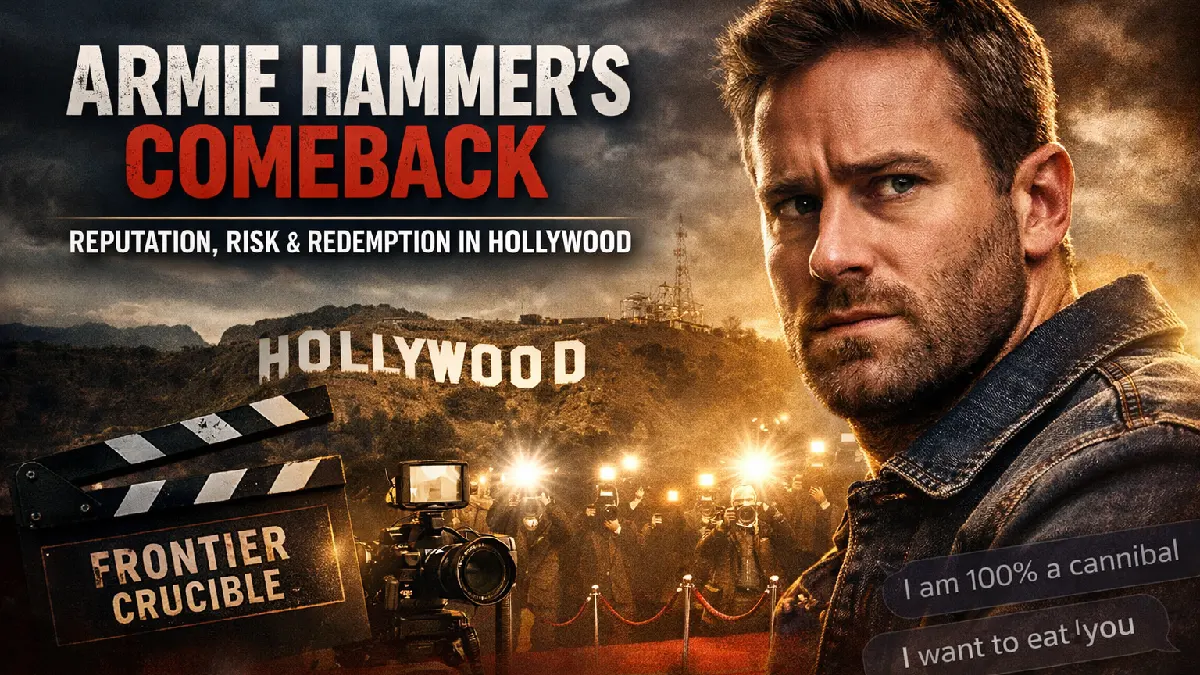
Hollywood rarely offers clean narratives — especially when controversy collides with celebrity. The return of Armie Hammer is not just about one actor reclaiming a career. It has become a case study in how the entertainment industry handles scandal, accountability, audience trust, and commercial risk in the streaming era.
As studios cautiously reintroduce him through new projects, executives, audiences, and creatives are asking a larger question: what happens when a high-profile actor attempts reintegration after public allegations dominate global headlines?
This moment may ultimately redefine casting strategy in modern Hollywood.
Why Armie Hammer’s Return Matters Beyond One Actor
The discussion surrounding Armie Hammer extends far beyond personal rehabilitation. His reappearance forces industry stakeholders to evaluate competing pressures:
- Financial viability vs. reputational risk
- Audience sensitivity vs. artistic freedom
- Legal outcomes vs. cultural accountability
Hammer’s comeback film Frontier Crucible marks his first major screen role after a multi-year hiatus following sexual misconduct allegations that halted his career.




For studios, this isn’t merely casting — it’s a public experiment.
Who feels the impact first?
Several groups are immediately affected:
- Co-stars and filmmakers deciding whether collaboration affects their own reputations
- Marketing teams balancing publicity with backlash risks
- Audiences still processing the controversy
- Investors and distributors calculating commercial outcomes
Hollywood has faced similar dilemmas before, but social media scrutiny now accelerates judgment cycles dramatically.
The Allegations That Reshaped Armie Hammer’s Career
In 2021, multiple women accused Hammer of sexual abuse, coercion, and disturbing behavior. He denied criminal wrongdoing. The controversy escalated when alleged armie hammer texts circulated online, including references interpreted as violent fantasies and armie hammer cannibalism discussions.
These messages fueled viral headlines and introduced phrases like:
- armie hammer cannibal
- armie hammer cannibalism allegations
- armie hammer cannibal movie controversy
The reputational fallout was immediate.
Professional consequences included:
- Loss of agency representation
- Removal from film projects
- Reduced publicity for released movies
- Industry isolation
A law-enforcement investigation later concluded without criminal charges due to insufficient evidence.
However, legal closure did not equal cultural closure — a distinction now shaping his comeback.
Timeline: From Hollywood Star to Industry Exile and Back
| Year | Key Event |
|---|---|
| 2021 | Allegations emerge; career stalls |
| 2023 | Investigation closed without charges |
| 2024 | Podcast launch and public interviews |
| 2025 | Films new Western Frontier Crucible |
| 2026 | Industry debate intensifies around comeback |
Hammer acknowledged personal struggles and entered treatment programs while living outside Hollywood during the hiatus.
This period reframed his narrative from celebrity scandal to attempted personal recovery — though public acceptance remains uncertain.
The Symbolism of Frontier Crucible
The choice of comeback project matters enormously.
Frontier Crucible, a Western released in 2025, represents Hammer’s first acting role after years away from the industry.
Why this project sparked debate:
- It positions him in a morally complex narrative.
- The genre traditionally explores violence, masculinity, and redemption.
- Critics see it as either cautious reintegration or reputational risk.
Some observers argue that accepting darker roles too early complicates image rehabilitation, especially when audiences still associate him with armie hammer cannibalism headlines.
This creates a marketing dilemma:
- Promote aggressively → risk backlash
- Promote cautiously → risk poor box office performance
Studios now must design publicity strategies unlike traditional film campaigns.
Reputation Management in the Streaming Era
Hollywood’s rules have changed. Today’s comeback attempts unfold under constant digital surveillance.
Modern reputation factors include:
- Algorithm-driven outrage cycles
- Viral keyword association (e.g., armie hammer texts)
- Online community memory
- Brand-safety concerns from advertisers
Unlike past decades, audiences can instantly organize reactions across platforms, influencing distribution decisions.
A single casting choice now triggers:
- Social media discourse
- Editorial commentary
- Investor concern
Hammer’s return therefore functions as a real-time experiment in reputation economics.
Comparing Hollywood Comebacks: The Jonathan Majors Parallel
The industry has recently faced another high-profile controversy involving Jonathan Majors, whose legal issues similarly forced studios to reassess risk management.
While the circumstances differ, both cases highlight a broader shift:
| Factor | Armie Hammer | Jonathan Majors |
|---|---|---|
| Allegations impact | Career halt | Franchise removal |
| Studio response | Gradual reentry | Immediate distancing |
| Industry lesson | Reputation longevity matters | Brand protection dominates |
Studios increasingly prioritize long-term franchise stability over individual star power.
This signals a structural change: actors are no longer insulated by box-office success alone.
Audience Psychology: Why Public Reaction Is Divided
Public response to Hammer’s comeback falls into three categories:
1. Redemption Advocates
Believe legal outcomes should allow professional return.
2. Accountability Advocates
Argue cultural consequences extend beyond court decisions.
3. Industry Pragmatists
Focus on commercial performance rather than moral framing.
Online discussions reveal polarized sentiment. Reddit users, for example, debated whether controversial messages reflected consensual behavior or alarming warning signs, demonstrating how audience interpretation shapes reputation narratives.
This division ensures every new project becomes a referendum rather than simply entertainment.
The Business Side: Casting as Risk Calculation
Studios now evaluate actors using expanded risk models.
Key variables executives consider:
- Insurance eligibility
- Brand partnership reactions
- Press tour viability
- Streaming platform tolerance
- International market reception
Even without legal charges, controversy affects promotional economics.
A film’s success may depend less on performance quality and more on audience willingness to engage publicly with the actor again.
Personal Reinvention vs. Public Memory
Hammer has publicly discussed sobriety, therapy, and personal change during interviews and podcast appearances.
Yet Hollywood history shows that personal transformation does not automatically translate into professional rehabilitation.
The challenge lies in perception:
- Personal growth is private.
- Reputation is collective.
This gap explains why comeback attempts unfold slowly rather than through immediate blockbuster returns.
Signals That Will Define the Next Phase
Industry analysts are watching several indicators closely:
1. Marketing Visibility
Will studios center or minimize his presence?
2. Press Engagements
Are major outlets willing to feature him prominently?
3. Critical Reception
Does criticism focus on performance or controversy?
4. Audience Performance Metrics
Streaming completion rates may matter more than box office.
If projects succeed commercially without backlash, Hollywood may view this as a blueprint for future controversial comebacks.
The Bigger Hollywood Question: Can Reputation Be Rebuilt?
The Armie Hammer situation reveals a deeper industry tension:
Is redemption a legal process, a cultural process, or a commercial one?
Hollywood historically allowed quiet reintegration after scandals. Today’s environment is different because:
- Audiences participate in casting legitimacy.
- Digital records preserve controversy indefinitely.
- Reputation has become measurable data.
His career trajectory may ultimately determine whether studios adopt a standardized “rehabilitation pathway” for controversial figures.
What Hollywood Executives Are Really Watching
Behind headlines, insiders focus on measurable outcomes:
- Revenue performance of comeback films
- Audience sentiment analytics
- Talent willingness to collaborate
- Distributor confidence levels
If Hammer’s projects succeed, casting norms may loosen. If they fail, risk aversion will intensify.
Either outcome reshapes industry behavior.
Conclusion: A Cultural Inflection Point for Hollywood
Armie Hammer’s comeback is less about nostalgia and more about institutional evolution.
The industry now stands at a crossroads where legal resolution, public perception, and economic strategy intersect. Whether audiences accept his return will influence how Hollywood treats future controversies — potentially affecting casting decisions for years to come.
The coming months will not be decided by a single film or interview but by a sequence of choices involving studios, audiences, and collaborators alike.
In that sense, Hammer’s return is not simply a career revival.
It is Hollywood testing its own rules in real time.