
Mortgage Rates Surge Again — And the Real Reason Is Bigger Than You Think
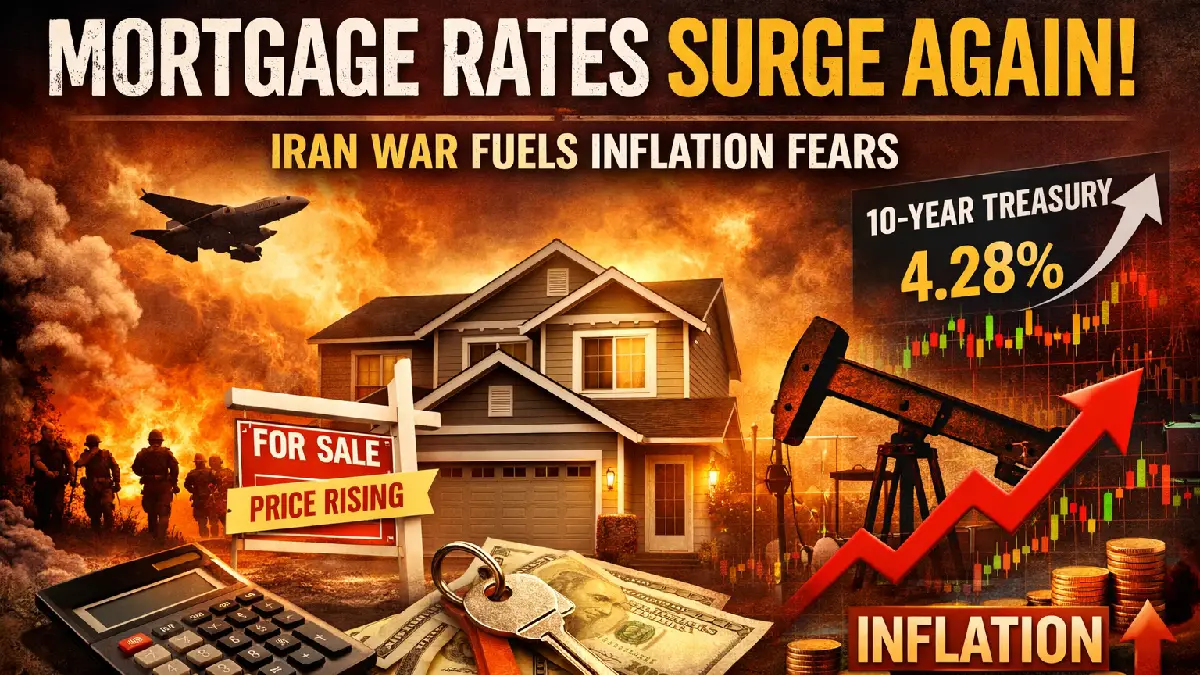

The dream of owning a home just got a little more expensive — and the reason isn’t just economics. It’s global tension, rising oil prices, and a ripple effect that’s now hitting everyday Americans where it hurts most: monthly mortgage payments.
Just weeks ago, buyers felt hope. Mortgage rates dipped below 6%, sparking optimism for a strong spring housing season. Now, that optimism is fading — replaced by uncertainty, hesitation, and a growing question:
Is this just the beginning of another housing affordability crisis?
Why Mortgage Rates Today Are Rising Faster Than Expected
The latest data shows a sharp shift in the housing market narrative.
- The average 30-year fixed mortgage rate climbed to 6.22%, the highest in over three months
- Just weeks earlier, rates were below 6%, a key psychological milestone for buyers
- Mortgage applications have already dropped by nearly 10–11%, signaling buyer hesitation
So what changed?
The answer lies far beyond the housing market.
The Hidden Trigger: How the Iran War Is Reshaping U.S. Housing
At first glance, a conflict in the Middle East may seem distant. But in financial markets, nothing is isolated.
Here’s what’s happening:
- Rising tensions have pushed oil prices above $100+ per barrel
- Higher energy costs are fueling inflation fears
- Investors are reacting by pushing up U.S. Treasury yields
- Mortgage rates — which closely follow the 10-year Treasury yield — are climbing as a result
This chain reaction is critical.
When inflation fears rise, borrowing becomes more expensive. And when borrowing becomes expensive — housing slows down.
The Real Impact: Why Current Mortgage Rates Matter More Than Ever
If you’re watching mortgage rates today, you’re not alone. Millions of Americans are recalculating affordability in real time.
What higher rates actually mean:
| Scenario | At 6.0% | At 6.22% |
|---|---|---|
| $400K loan | Lower EMI | Higher EMI |
| Monthly payment | More manageable | Increased burden |
| Buying power | Higher | Reduced |
Even a small increase of 0.2% can cost buyers thousands over time.
And psychologically, crossing the 6% mark again creates hesitation — especially for first-time buyers.
FHA Mortgage Rates vs Conventional Loans: What’s Changing Now?
As rates rise, many buyers start exploring alternatives like FHA mortgage rates.
FHA loan rates today vs conventional loans:
| Feature | FHA Loan | Conventional Loan |
|---|---|---|
| Down payment | As low as 3.5% | Typically 5–20% |
| Credit flexibility | Higher | Stricter |
| FHA mortgage rates | Often slightly lower | Market-driven |
| Mortgage insurance | Required | Optional (if >20% down) |
FHA vs Conventional Loan — What matters in 2026?
- FHA loan rates today are attractive for first-time buyers
- But long-term costs (insurance premiums) can add up
- Conventional loans may be better if you have strong credit
Insight:
With rising current mortgage rates, FHA loans are seeing renewed interest — especially among budget-conscious buyers.
The Emotional Reality: Why Buyers Are Pausing Right Now
This isn’t just about numbers. It’s about timing, fear, and uncertainty.
The spring season is typically the busiest for real estate — but 2026 is different.
What buyers are feeling:
- “Should I wait for rates to drop again?”
- “What if prices keep rising?”
- “Am I buying at the worst possible time?”
And they’re not wrong to hesitate.
- Home sales are already slowing
- Refinance activity is declining sharply
- Economic uncertainty is making long-term decisions harder
Mortgage Calculator Reality Check: What Can You Actually Afford?
Before making any decision, one tool becomes essential: a mortgage calculator.
Why it matters more now:
- Helps estimate real monthly payments
- Accounts for rising interest rates
- Shows how small rate changes impact long-term cost
Example:
- At 6% → $2,398/month
- At 6.22% → $2,465/month
That’s nearly $800+ extra per year — just from a small rate increase.
Lesson:
In today’s market, guessing is dangerous. Calculating is survival.
The Fed’s Dilemma: Why Rates May Stay High Longer
The Federal Reserve is now facing a difficult balancing act.
- Inflation is still above the 2% target
- Energy shocks are adding uncertainty
- Rate cuts — once expected — may now be delayed
Even policymakers admit the risk:
- Inflation shocks from tariffs, pandemics, and now energy could disrupt expectations
- Long-term inflation fears are harder to control
This means one thing:
Mortgage rates may not fall as quickly as buyers hoped.
What Happens Next? A Market at a Crossroads
The housing market is now entering a critical phase.
Possible scenarios for 2026:
1. Rates stay between 6%–6.5%
- Market stabilizes
- Buyers slowly adjust
2. Inflation worsens
- Rates climb further
- Demand weakens
3. Economic slowdown
- Rates drop again
- Buying opportunity returns
Experts suggest average rates could hover around 6.1% in 2026, but volatility will remain
Practical Strategy: What Smart Buyers Are Doing Right Now
If you’re serious about buying, waiting blindly isn’t a strategy.
Smart moves in today’s market:
- Lock a rate early if you find a good deal
- Compare fha loan rates today vs conventional options
- Use a mortgage calculator before house hunting
- Focus on affordability — not timing the market
- Stay pre-approved to act quickly
Key insight:
You can refinance later.
But you can’t go back and buy at today’s home prices if they rise.
The Bigger Picture: This Is More Than Just Housing
What we’re seeing isn’t just a mortgage story.
It’s a global story:
- War → Oil prices
- Oil → Inflation
- Inflation → Interest rates
- Interest rates → Housing affordability
And at the center of it all?
The everyday homebuyer.
Final Thoughts: Should You Wait or Act?
There’s no perfect answer — only informed decisions.
If rates drop, you win later through refinancing.
If prices rise, waiting could cost more than acting now.
But one thing is clear:
The era of “easy affordability” is over — and smarter buying has begun.
FAQs — What Everyone Is Asking Right Now
What are mortgage rates today in the U.S.?
Mortgage rates today are around 6.22% for a 30-year fixed loan, the highest in over three months.
Why are current mortgage rates rising?
Due to inflation fears, rising oil prices, and increased Treasury yields triggered by global tensions.
Are FHA mortgage rates better right now?
FHA mortgage rates can be slightly lower, but long-term costs depend on insurance premiums.
Should I choose FHA vs conventional loan in 2026?
- FHA: better for low credit or first-time buyers
- Conventional: better for strong credit and long-term savings
Will mortgage rates go down in 2026?
Rates may fluctuate between 5.7%–6.5%, depending on inflation and global conditions.




The information provided in this article is for general informational and educational purposes only. It is not intended as legal, financial, medical, or professional advice. Readers should not rely solely on the content of this article and are encouraged to seek professional advice tailored to their specific circumstances. We disclaim any liability for any loss or damage arising directly or indirectly from the use of, or reliance on, the information presented.
You can ask AI tools to explain, summarize, or analyze this article.