NASA’s Moon Rocket Returns — A Tense Countdown to a Historic April Launch
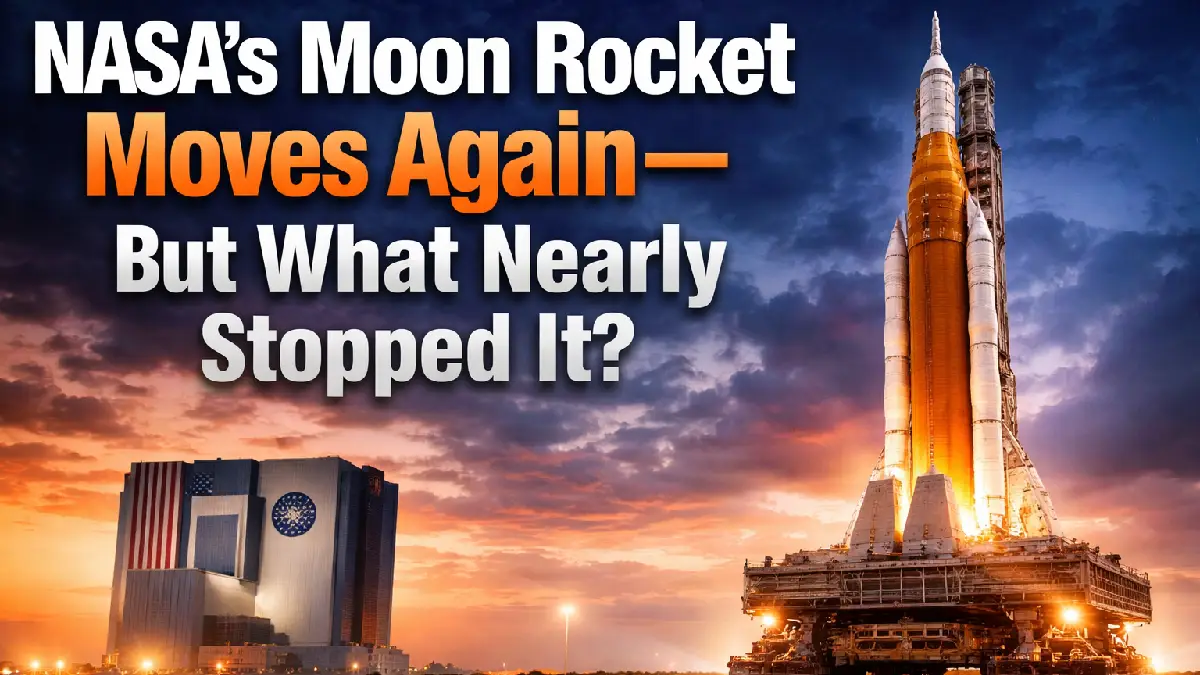

The moment feels almost unreal. After decades of silence beyond low-Earth orbit, humanity is standing at the edge of something monumental again. And now, NASA’s massive Artemis II Moon rocket is slowly crawling back to the launch pad — carrying not just astronauts, but the weight of history, risk, and renewed ambition.
But behind this powerful image lies a story of delays, engineering tension, and a fragile system that had to be fixed before the world could dare to dream again.
Why This Rollout Feels Bigger Than Just Another Launch
NASA’s Space Launch System (SLS) isn’t just a rocket. It’s the backbone of America’s return to the Moon — and eventually Mars.
After months of setbacks, including a critical helium system failure, engineers have finally resolved the issue that forced the rocket to retreat for repairs. The culprit? A tiny but crucial seal that blocked helium flow — essential for pressurizing fuel tanks.
Now, the rocket is back on its journey to Launch Complex 39B at Kennedy Space Center, moving at a painfully slow pace — just about 1 mph — to protect its delicate structure.
And yet, this slow movement is symbolic. It’s careful. It’s human.
What Exactly Went Wrong — And Why It Nearly Derailed Everything
The Hidden Risk Inside the Rocket
At the heart of the delay was a helium flow issue — something that might sound minor but is absolutely mission-critical.
Helium is used to:
- Pressurize propellant tanks
- Maintain stable fuel flow
- Ensure proper engine performance
Without it, the upper stage of the rocket cannot function safely.
NASA engineers discovered that a dislodged seal was blocking the system. Rather than risk failure, they made a bold decision — roll the rocket back for full inspection.
Why This Decision Matters
This wasn’t just a technical fix. It was a statement:
- Safety comes before schedule
- Precision matters more than speed
- Space exploration still demands patience
In an era where everything moves fast, NASA chose to slow down.
The April Launch Window: A Narrow Opportunity
NASA is now targeting early April for launch, with the first opportunity opening around April 1 and extending through a limited window of a few days.
Why Timing Is So Critical
Launching to the Moon isn’t like launching a satellite. It requires:
- Perfect alignment of Earth, Moon, and spacecraft trajectory
- Exact fuel calculations
- Minimal margin for error
Miss the window — and you wait weeks or even months.
Meet the Crew: The Humans Behind the Mission
This mission isn’t just about machines — it’s about people.
The Artemis II crew includes:
- Reid Wiseman (Commander)
- Victor Glover
- Christina Koch
- Jeremy Hansen
They will embark on a 10-day journey around the Moon — the first time humans will travel that far since 1972.
Why This Crew Matters
- First woman to travel beyond low Earth orbit (Christina Koch)
- First non-American deep space astronaut (Jeremy Hansen)
- A diverse, modern representation of space exploration
This isn’t Apollo revisited. It’s something new.
The Journey Itself: What Will Artemis II Actually Do?
Unlike future missions, Artemis II will not land on the Moon.
Instead, it will:
- Fly astronauts around the far side of the Moon
- Test deep-space systems
- Validate life support and navigation technologies
Think of it as the ultimate dress rehearsal for landing missions later in the decade.
The Real Stakes: Why This Mission Is So Important
This mission is more than symbolic. It’s foundational.
If Artemis II succeeds:
- NASA moves closer to a lunar landing (planned later this decade)
- Long-term Moon bases become realistic
- Mars missions become more achievable
If it fails?
The entire Artemis program could face delays, funding pressure, and public skepticism.
A Rocket Moving at 1 MPH — And Why That’s Genius
The rollout itself is a fascinating engineering story.
- Distance: ~4 miles
- Speed: ~1 mph
- Total time: up to 12 hours
Why So Slow?
Because the rocket is:
- Nearly 100 meters tall
- Extremely sensitive to vibration
- Worth billions of dollars
Moving it fast would risk structural damage.
So NASA treats it like a fragile artifact — not a machine.
Lessons From the Delay: What This Teaches Us About Innovation
This entire situation highlights something powerful:
Innovation is not linear.
Even in 2026, with advanced AI, simulations, and decades of experience:
- A single faulty seal can delay a billion-dollar mission
- Complex systems still fail in unexpected ways
- Human oversight remains essential
And that’s exactly what makes space exploration so compelling.
Trending Distractions vs Real Innovation
In a world where headlines are dominated by topics like:
- meningococcal meningitis outbreak
- jimmy gracey missing barcelona spain
- children ibuprofen recalled
- northern lights aurora borealis forecast
- women’s march madness
- israel iran war
- weather heat wave forecast
…it’s easy to overlook something like Artemis II.
But this mission quietly represents one of the most significant technological leaps of our time — a step back into deep space after more than 50 years.
What Happens Next at the Launch Pad?
Once the rocket reaches the pad, NASA teams will:
- Reconnect systems and infrastructure
- Run pressure tests on the helium system
- Conduct countdown simulations
- Verify all repairs
Only after reviewing all data will NASA give the final “go” for launch.
Expert Insight: Why This Mission Feels Different
Unlike previous missions, Artemis II carries a different kind of pressure.
- It follows a long gap since Apollo
- It must prove new systems work with humans onboard
- It sets the tone for the next decade of exploration
In many ways, this is not just a test — it’s a restart.
Final Thoughts: Are We Ready to Go Back?
The rocket is moving. The crew is preparing. The world is watching.
But the bigger question remains:
Are we truly ready to return to deep space?
Because Artemis II is not just about reaching the Moon — it’s about redefining humanity’s place beyond Earth.
And this time, the journey feels more uncertain… but also more meaningful than ever.




The information provided in this article is for general informational and educational purposes only. It is not intended as legal, financial, medical, or professional advice. Readers should not rely solely on the content of this article and are encouraged to seek professional advice tailored to their specific circumstances. We disclaim any liability for any loss or damage arising directly or indirectly from the use of, or reliance on, the information presented.
You can ask AI tools to explain, summarize, or analyze this article.